

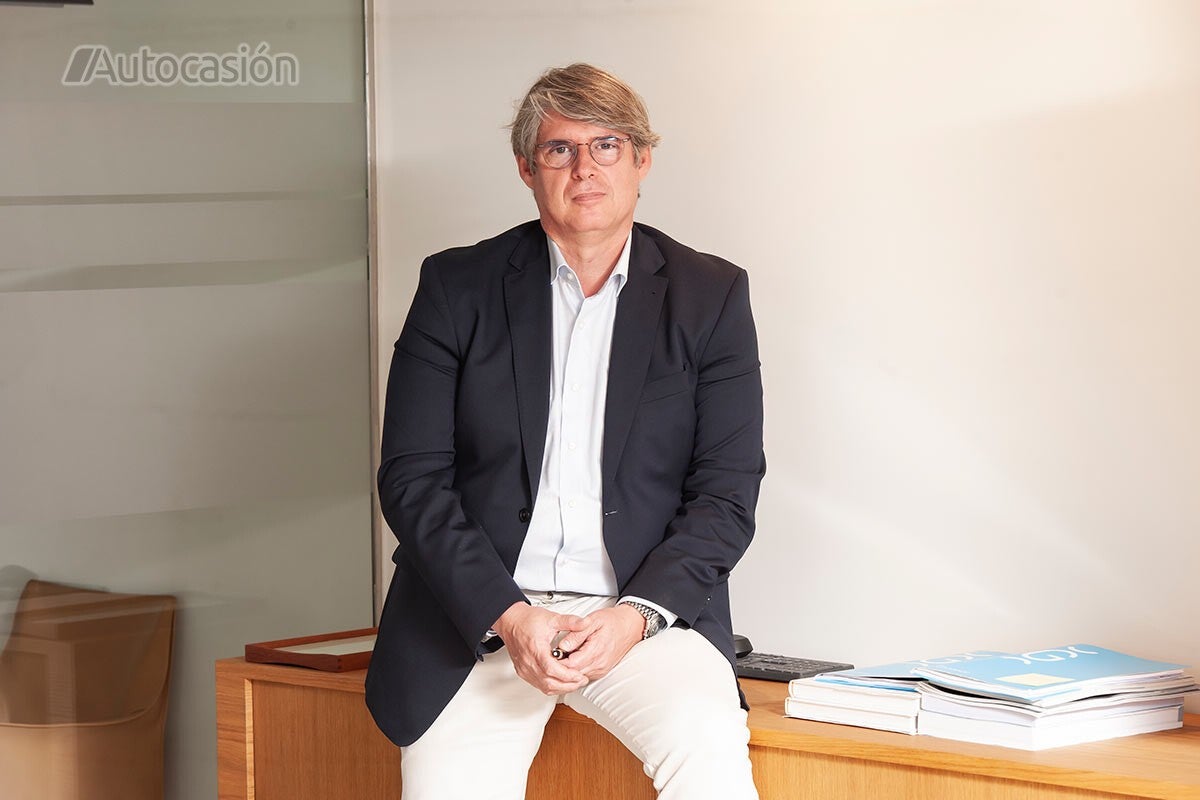
 Mark Diego
November 14, 2022
We asked the president of the National Association of Motor Vehicles, Repair and Spare Parts Sellers about the upcoming celebration of eXpo Ganvam and the situation of a sector that is in the process of transformation.
On November 15, the second edition of eXpo Ganvam, a meeting point for the vehicle distribution sector, will be held at IFEMA (Madrid). In a complicated context marked, moreover, by the inefficiency in the management of European recovery and transformation funds, the annual Ganvam congress will address the main challenges faced by a sector in the process of adapting to mobility as a service .
Ask: The second edition of eXpo Ganvam will be held on November 15. What are the main axes going to be and what can it contribute to the sector?
Answer: The objective and raison d’etre of eXpo Ganvam is to provide answers and tangible solutions to the distribution sector (vendors, repairers, related activities…) at a time when the business model is being transformed as a consequence, mainly, of the digitization and electrification of the park; We are going from being an automotive industry to being a mobility industry and we assume the responsibility of accompanying and helping the sector in this transition. For this reason, one of the axes of this second edition will be the European funds. It is necessary for the Public Administrations to guarantee a flow of sufficient resources to support the transformation of the 42,000 SMEs and 35,000 self-employed in the sale and repair of vehicles that exist in Spain and are currently excluded by the Government from the distribution of aid. That is why we are accompanied by the leader of the opposition, Alberto Núñez Feijóo, or the spokesman for the European Parliament’s Transport Commission, Jose Ramón Bauzá, with whom we share the diagnosis of the situation.
Q: eXpo Ganvam arrives at a time of economic uncertainty and in which the sector continues to drag the semiconductor crisis. What messages are going to be launched to help the sector weather the storm?
A: Experts and strategic partners are going to launch clarifying messages that facilitate decision-making, which is not a small thing. To give a couple of examples: Mónica Oriol, who has been a professor of Economic Policy at the Complutense and St. Louis University and who currently chairs Net4Things -specialized in the development of software for mobile connectivity- being a counselor as well as a consultant NTT Data, will analyze us with what chiaroscuro Spain finds itself as a destination for technological investment; or actors like Porsche and Flexicar are going to reflect and debate together on how to get a competitive advantage from the waiting list at a time like this, when there is a lack of stock.
Q: In what situation is the demand of the sector? Is it alive, waiting or asleep?
A: Whenever the economic outlook is uncertain, demand shrinks because investment confidence falls. We are at a time when, in addition to the impact of tensions in the supply chain, there is also the drift of changes in monetary policy to deal with inflation, with increasingly expensive loans. In a market like ours, in which 80% of operations are financed, the rise in financing costs slows down purchases. In the second edition of eXpo Ganvam we will have the main financial institutions present -BBVA Consumer Finance, Caixabank Payment & Consumer, Santander Consumer Finance and Cetelem- who will show us their points of view to guarantee that mobility does not become a luxury within the reach of a few.
Q: In the case of Sumauto, what role is it playing in the sector? Even more so, at a time when specialized portals are evolving to Marketplace
A: On November 15th you will have the opportunity to demonstrate it in a showcase like eXpo Ganvam. You will be present together with Coches.net and Coches.com, so it will be very interesting to see the joint vision of all the actors and highlight your function within the new distribution model.
Q: eXpo Ganvam is also digitization, connectivity, electromobility… What can the sector do to help buyers and respond to their mobility needs?
A: Mobility must guarantee social cohesion, it must be inclusive. This is what needs to be guaranteed. Currently, policies are being developed that focus on accessible solutions for a minority. Therefore, in addition to defending financing as a tool to democratize mobility, from the sector we advocate a redesign of incentive plans that, without losing sight of the urgent objective of rejuvenating the park, are capable of directing demand towards efficient mobility, but without going against the private vehicle and without depriving the citizen of the right to affordable and accessible mobility.
Q: The entry into force of the Low Emission Zones in 2023, what opportunity will it represent for the sector?
A: More than an opportunity for the sector, I would say that it is once again a demonstration of the need to launch effective incentive plans for scrapping. With the entry into force of the low emission zones, nearly four million cars will see their circulation compromised because they do not have a label. I insist that the ecological transition must be fair in social terms and cannot exclude large sections of the population for economic reasons.
Q: What is the sector forecast for 2023? Will it be a payback year?
A: The forecast that we manage for 2023 is to stay at around 915,000 units, when it is assumed that by level of motorization, population and income per capita our market is 1.2 million units. The reflection that I am considering is whether, in the same way that the volumes prior to the 2008 economic crisis have not been recovered, it will be possible to recover the pre-pandemic levels. Trends such as mobility by subscription -which in 2030 will concentrate almost 7 out of every ten registrations- make us think that we will witness a reduction in the volume of the fleet in favor of a higher rate of use of vehicles.

