

Years ago in Spain the tortilla was turned around and more used cars are sold than new ones. The second-hand market already moves as much money as the new one, but most of the sales correspond to cars with more than ten years. Most people look for cheap cars that they can easily pay for with cash, without getting into a car loan.
The high demand for these cars “mileuristas”” It has caused them to rise in price a lot in recent years. They are old cars, which may have a serious problem. Furthermore, 60% of transactions are between individuals, which offers fewer guarantees. That is why it is essential to locate cars with problems, before having to regret it or report it for hidden defects.
We have compiled a series of tips to help you discover those possible failures in a second hand car. There are three fundamental steps:
For this last point, the ideal is for a professional mechanic to check a car, but it is not very common in these cars in which savings are sought. Hence, with a few tricks, serious problems can be located, with a step-by-step vehicle inspection:
1. Boot
A car with electronic injection should start immediately. If the car doesn’t do it or the idle is stable (the rev needle stays at one point and doesn’t oscillate), there could be serious problems of various kinds that imply a future significant outlay of money (fuel system, lack of compression in some cylinder…)
2. Address
Once underway, check that the steering returns to straighten up when you turn. Use an old trick: when you’re going in a straight line (about 80 km/h), let go of the wheel and check that the car isn’t going somewhere. When stationary, turn the steering wheel all the way to one side and the other to check that you don’t hear any clicks (symptom of a serious problem). If it is assisted, check that it does not cost more to turn to one side than to the other.
3. Transmission
Transmission is the system that transmits the force from engine to wheels (for a set of gears). If there is a clicking noise when turning and accelerating, it is a sign of problems. You have to pay attention:
- To the rubber joints available before their connection with wheels.
- Possible oil leaks in the area where it joins the gearbox.
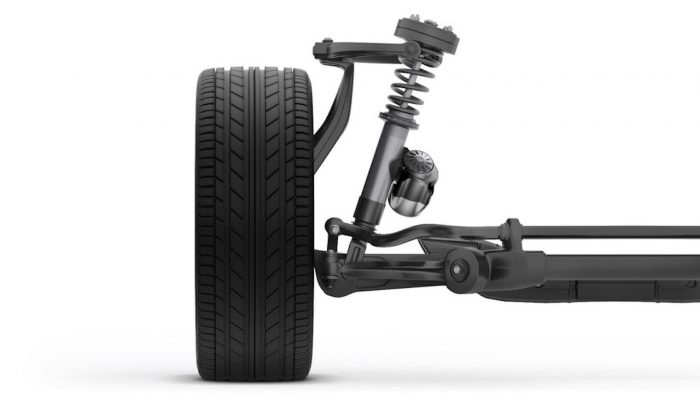
4. Suspension
Shock absorbers are key to road safety. Not only do they prevent our car from bouncing out of control on the road, but they keep the tires in contact with the road and control body oscillations. To know the state of the shock absorbers there is a trick: push hard on the car, just above each wheel. When it reaches the point of maximum compression, release and see what happens. If there is a bounce when you return, it is a sign that the shock absorbers are not very good.
They will be in poor condition and you will need to change them if:
- If you perceive that they occur oscillations when drivingor if you notice oil stains when looking behind the wheels.
- Yes, at To brake drythe vehicle sinks more to the front, drifts to the sides, or is difficult to control.
- If when driving the steering wheel vibrates, even if the pavement is in good condition. If you’re going over potholes and notice that your wheels are bouncing too much, it’s also a sign that they should be replaced.
5.Exhaust
The color of smoke coming out of the tailpipe implies different problems. A blue smoke it indicates oil consumption (worn engine and very expensive repair), if it is white it means that there is a lack of fuel in the combustion and if it is black it consumes too much fuel. The arrangements are less expensive in these cases.
6. Headlights
Check that all the car lights work (position, long, short, fog, reverse and turn signals). If they don’t, it could be from a light bulb or a fuse (little thing) to a failure in the light control unit. if the intensity it is not constant, it could be due to the alternator or the wiring.
7. Liquids
Car fluids are the blood of its mechanics. Ask when the last change was made and if you have papers or invoices to prove it. Changing them is cheap, but solving the problems that they can give are already more expensive.
- Oil: Neither too black nor too viscous.
- Brake fluid: If it is in poor condition it will be very dark.
- Coolant liquid: There are different colors depending on the brands, check the level is correct, otherwise it could indicate a leak.
8. Change
The gears should not have gaps between them and should enter smoothly. In neutral, step on the clutch. If it makes noise, you may have to change the gearbox fluid.
A trick to check the clutch status is to put the handbrake, put the second gear and try to start the march. If it doesn’t stall, the clutch is worn and will need to be changed soon.
9. Brakes
If they let you test drive the car, brake hard. If the car goes to one side, there are disc or pad problems. There are more tricks to detect problems with the brakes. It is important that you check that the ABS works (fix is more expensive). To do this, it is best to test it on a dirt road at low speed and brake hard. If the pedal does not vibrate, the ABS is not working.
10. Air conditioning
Also check that the air conditioning expels Cold air in less than a minute. You may need a gas recharge (around 50 euros) or there are leaks in the circuit (a more expensive fix).
Photos: cc Flickr Thomas Hawk,

