

Almost a year ago we knew smart #1 live… but standing still. Since we saw Concept #1 in the fall of 2021, we wanted to see what would come of this new smart, a joint venture between the German Daimler and the Chinese Geely. That moment to put the Smart #1 to the test finally arrived.
Launching a brand is not just having cars. Despite the fact that the brand is not going to have dealers as such, a network of agents has had to be created that will deliver the cars. There are already 26, distributed throughout the Spanish geography, in Mercedes dealerships. And work is being done to increase the after-sales network (it doesn’t matter so much where to buy it, but it does matter that there is assistance nearby).
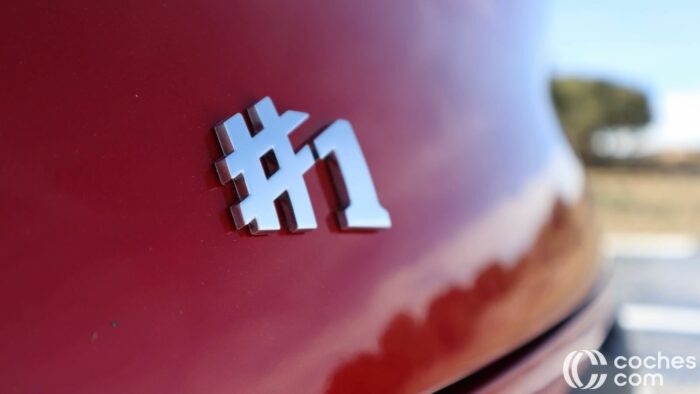
Deliveries of the smart #1 began in Germany at the beginning of the year and in Spain it can already be reserved (with a pre-reservation of 500 euros that 300 people have already paid), although deliveries to customers will be after the summer.
With a starting price of €42,100 From this smart #1 Pro + access version you can now find Smart #1 offers in our new car section, as well as calculate the financing of the car to find out how much each installment would cost. But first, let’s get to know it in depth, with the first production cars with Spanish registration.
Abroad
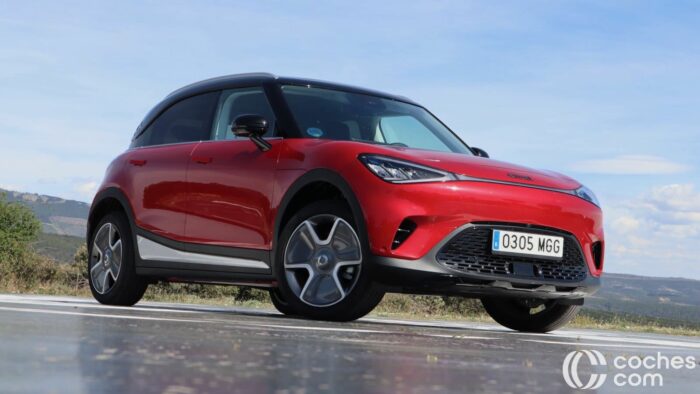
The smart fortwo is still on sale for now. And we say this because the #1 smart seems to be escaping from that idea of the perfect tiny car for the city. Now it is an SUV, with dimensions quite far away.
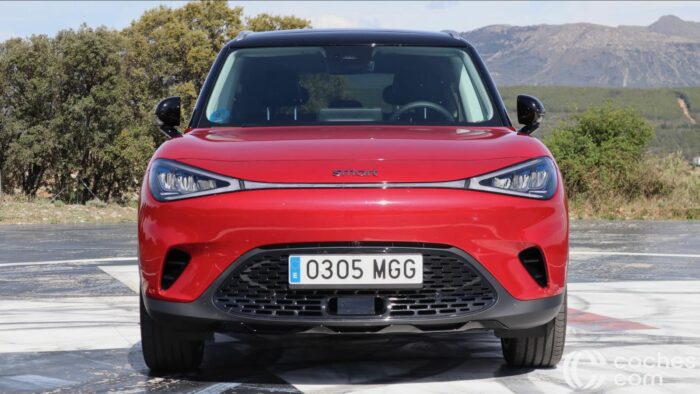
The smart #1 measures 4,270 mm in length, just 3 cm less than a MINI Countryman. Weight is interesting its wheelbase, 2.75o meters, an excellent number. To put you in situation, a Mercedes B-Class has 2,729 mm. Other measurements are 1,636 high and 1,822 mm wide. It is based on Geely’s open source SEA (Sustainable Experience Architecture) platform, which is expected to be the basis of a future Volvo XC20.
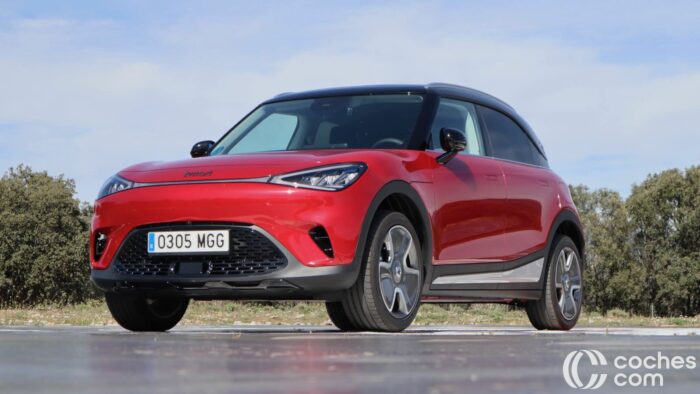
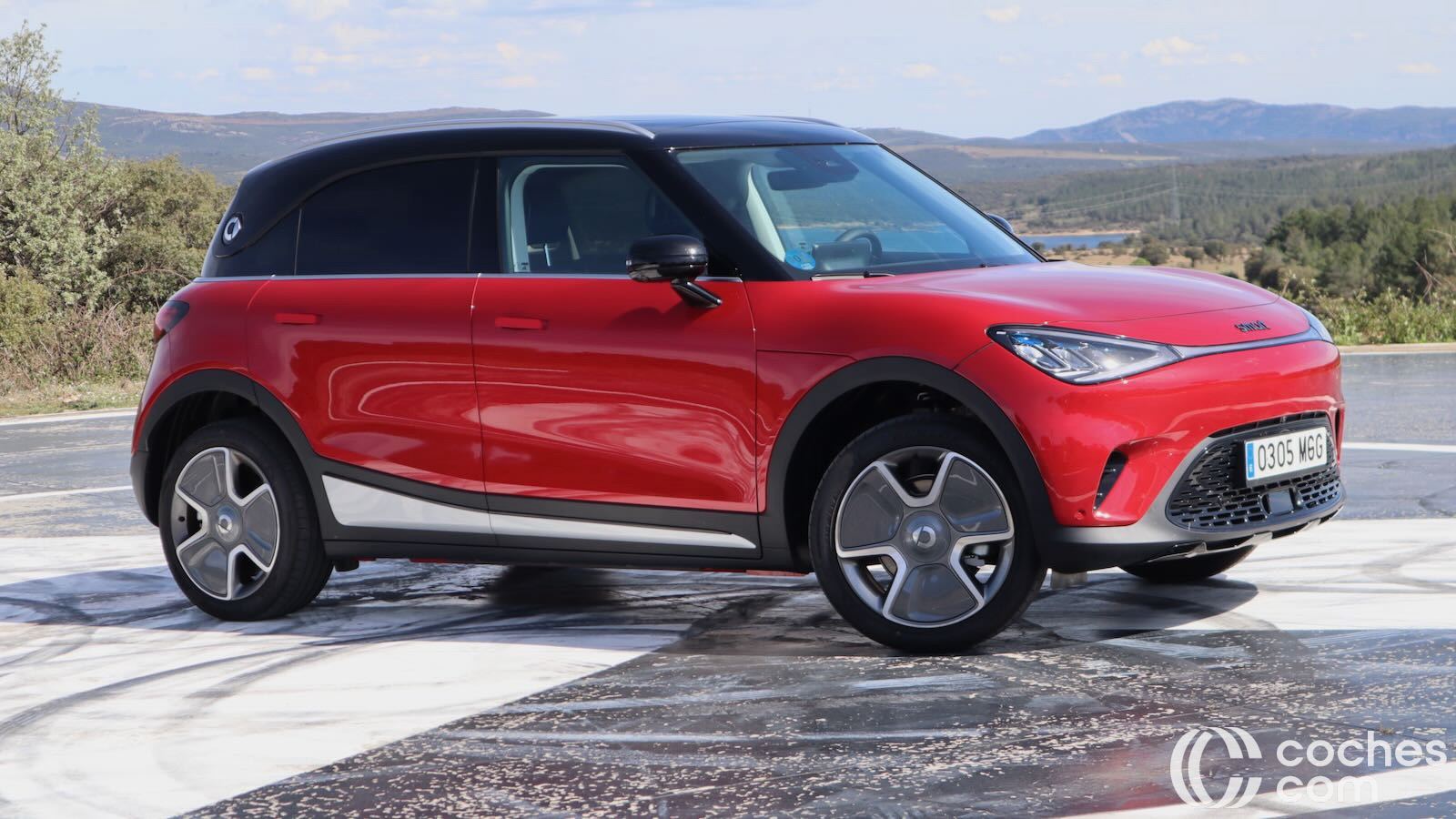
There are features that make it akin to the Mercedes EQA, especially the very smooth rounded surfaces of the body panels. However, it has its own image, very modern. At the front, the C-shaped optics are joined by an LED strip and on it is the logo of the brand. Except for the entry-level version, it has CyberSparks LED+ (Adaptive Matrix Full LED headlights).
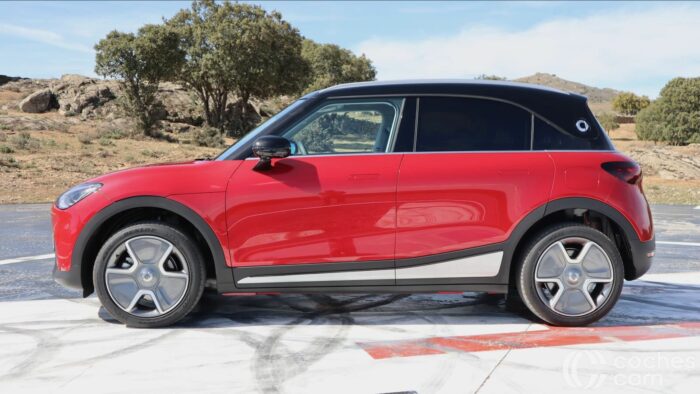
The air intake is in the lower part, also rounded, with some small ones at the ends that shape the bumper. In the lower area, a black plastic protection that enhances the crossover image and extends through the wheel arches (there are alloy wheels up to 19 inches) and underbody.
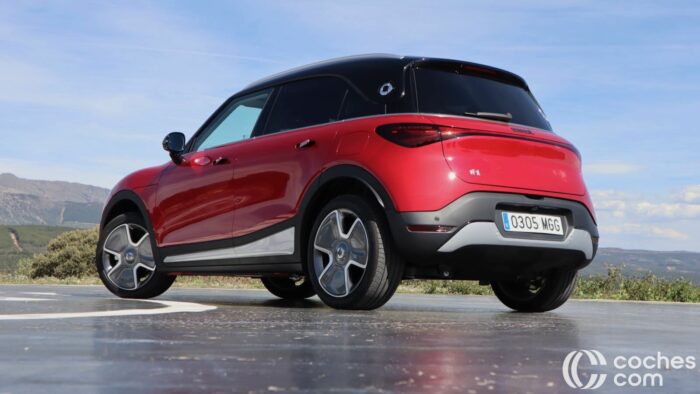
On the side we also see roof bars and two details that we liked. The first, the handles flush with the body, which improve aerodynamics and the frameless windows. As in the case of our unit, you can choose a body in two colors, with a contrasting roof. There are no more options, all the customization is associated with the different trim levels (Pro+, Premium and Launch Edition –a special launch edition– and Brabus –the sportiest finish–). In total there are 31 options to choose from (9 for the Pro+, 14 for the Premium and 7 for the Brabus).
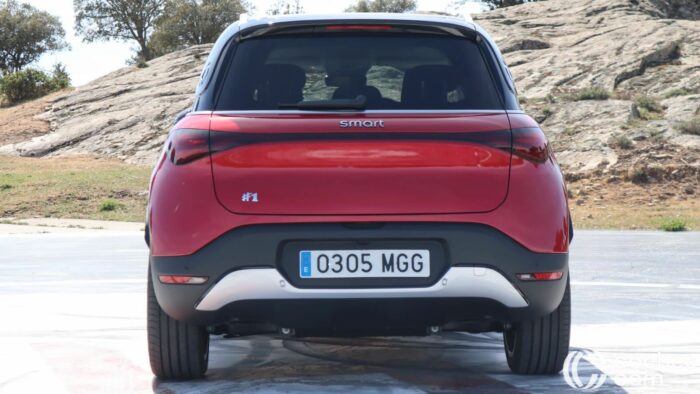
At the rear, the headlights follow a scheme very similar to the one we see at the front, joined by a strip of red light. The rounded shapes and protections in the lower area are also repeated.
Inside
You open the door and find a very minimalist and technological environment, where a 9.2-inch horizontal instrument panel is combined with a 12.8-inch multimedia unit from which you can do practically everything, including adjusting the position of the rear-view mirrors. . Its operating system is really smooth and has a very modern interface. Will update again in June OTA. The voice assistant above all (after using it, I attest that they should do so).
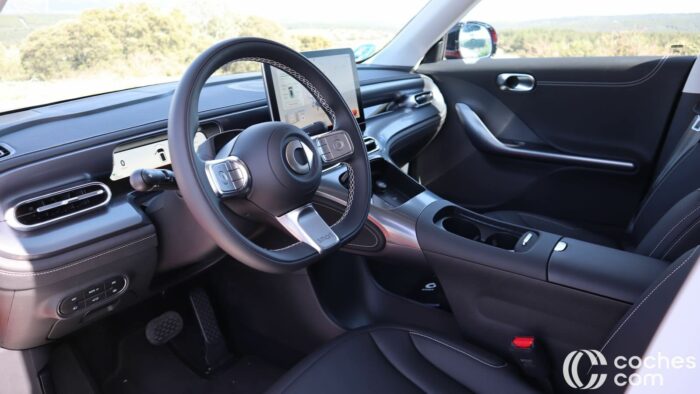
The colors vary according to the equipment line and depend on the exterior colour. The feeling of quality is good, but not superb. One expected something more from that section, hopefully some settings will improve as more units come out of the factory. The second key is digital. It’s not available yet (it’s coming) and it’s free to share for the first year.
There is a large and flattened steering wheel at its base, with just buttons that control the multimedia system or driving assistants. As standard it boasts a 2+ driving level: adaptive cruise control with Stop & Go function, highway and traffic jam assistant, 360-degree camera…
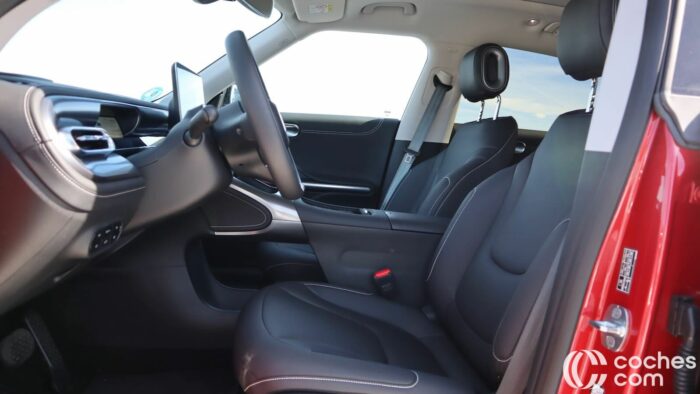
The driving position is not very SUV and that, to me, convinces me. Space is not bad if you are not very wide. In this case, perhaps the center console can overwhelm some. I like that separation between driver and passenger, since you gain several compartments to leave things and another one under it, very practical.
Within the standard equipment we have front seats with electrical adjustments, dual-zone climate control (with heat pump from the Premium finish), wireless charging base, ambient lighting with 64 colors or an automatic parking assistant.
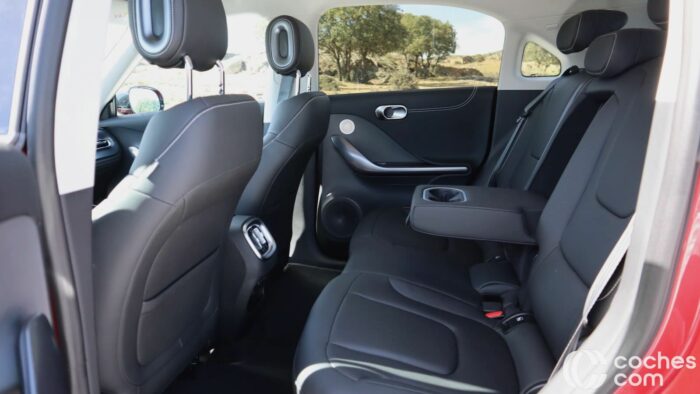
The space in the rear seats is excellent, especially considering the exterior dimensions of the car. It stands out in its available height and modularity, with a bench that can be moved longitudinally by 13 cm and seats that can be reclined in different positions. There is no lack of air vents or a folding armrest.
The Smart #1 has a trunk of 323 liter capacity, in the mean of the segment. This figure is reduced by 10 liters in the Brabus version. As the rear bench is sliding it can vary between 273 and 411 litersexpanding or reducing space for rear passengers.
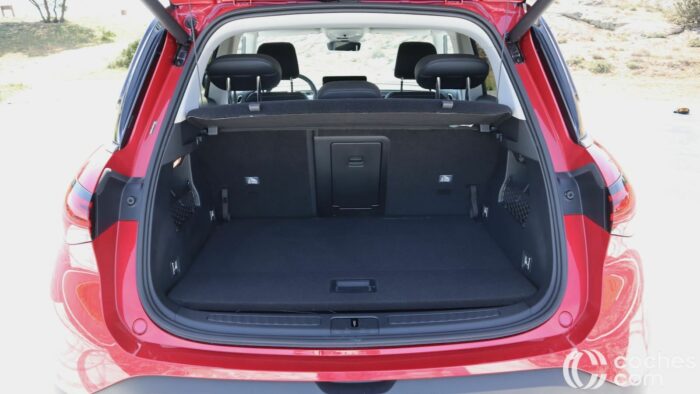
Under the floor we have a double bottom and also with hangers, load restraints or some lateral spaces with a net on the sides. Under the hood we have a frunk (front trunk) barely 15 liter capacity but where the charging cables can be carried without problem.
Engine
Our test unit was of the Pro+ trim. It is moved by a motor 262 PS (200 kW) associated with a 66 kWh capacity battery that gives for 420 km autonomy. It is an NMC (lithium, nickel, cobalt and manganese) battery, which has an eight-year warranty. Supports loads of 7.4 kW in alternating current and 150 kW in direct current.
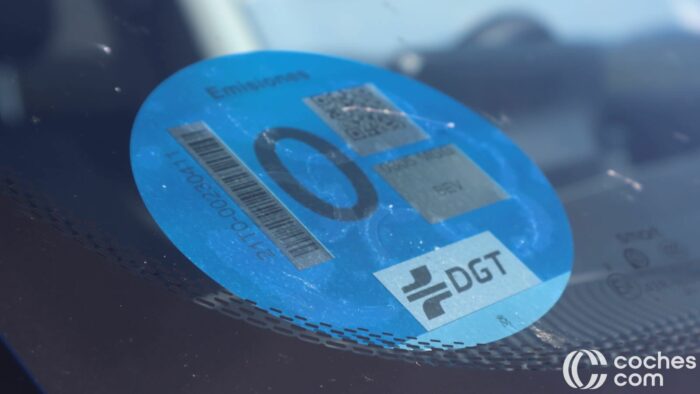
The premium versions have a heat pump, so the approved autonomy increases to 440 km. In this sense, it should be noted that the hello Smart app (for now only available in Germany) will allow you to pre-climate the passenger compartment –not the battery–, in addition to monitoring the load, remote control of lights, windows or doors. geolocate the car, see charging points, access manuals or contact the customer service center…
On the other hand there is the Brabus version. announces 315 kW (428 hp) of power resulting from combining two engines. It is capable of accelerating from 0 to 100 km/h in 3.9 seconds. Something unique in the market and perhaps for this reason it is the one that is receiving the most orders from the start. But be careful, as you will see, the basic version is already going really well.
Behavior
I have not driven the Brabus but it seems to me that the 272 CV of the conventional versions can move the car really well (it weighs 1,788 kg). Circulating with two people you gain speed very well in any circumstance, either from a standstill (complete the 0 to 100 km/h in 6.7 seconds) or when overtaking or joining highways.
The top speed has been limited to 180 km/h. It is something common in electric cars when it comes to not spending a lot of battery in a short time. And speaking of consumption, we covered 105 km with the car in this contact test. Around 60% of the route, on highway at high speeds. And the average consumption was 17.9 kWh/100 km, with peaks of 22 kWh/100 km on slopes at 120 km/h. Approves 17.4, so we can talk about normal spending in these environments, with a range of about 370 km. In any case, we will wait for a more in-depth test to better compare these data.
Despite its weight, you don’t feel the car slow or clumsy when driving on back roads with very slow hairpin turns. It helps it have a firm tread on the huge 235-wide tires and how quickly it responds to the throttle. You have several ECO, Comfort and Sport driving modes that vary the power delivery when you accelerate.
These modes also change the hardness of the steering, without it being considered sporty, but it has an adequate feel. And it is also possible to vary the retention in three levels (standard, strong and e-Pedal) to achieve greater energy regeneration. In this sense, seeing the car’s abilities, I would have preferred paddles to control it in cornering areas (they are not even available in the Brabus), which also get you more involved in driving.
Opinion cars.com
Good sensations with the smart #1 after this first contact test. It has a good footprint and more than enough features. The interior is spacious for four, without having exaggerated dimensions at all. If you want more, the range will increase with the #3 at the beginning of 2024, something longer and with a coupé air.
Without dealers, the brand is also currently working to offer leasing and a short-term subscription model is valued. It is not strange, since this type of urban approach models can have occasional use. It also wants to overcome misgivings about the electrical system by offering a charging card that gives access to all points of Digital Charging Solutions (at a base cost of 37 cents + the energy that is charged is pay-per-use) and another with iberdrola install a charging point and access Iberdrola’s public charging in the first 6 months (in principle through the Iberdrola app).
Its price seems high, but those 42,100 euros do not include the aid of the Moves III Plan and it is not exaggeratedly larger than other electric SUVs of its size, such as a Hyundai Kona Electric, the KIA e-Niro or the DS 3 E. -Tense, its most direct rivals.
Photo gallery:
 1/43Photos
