


2 photos
 Mark Diego
November 15, 2022
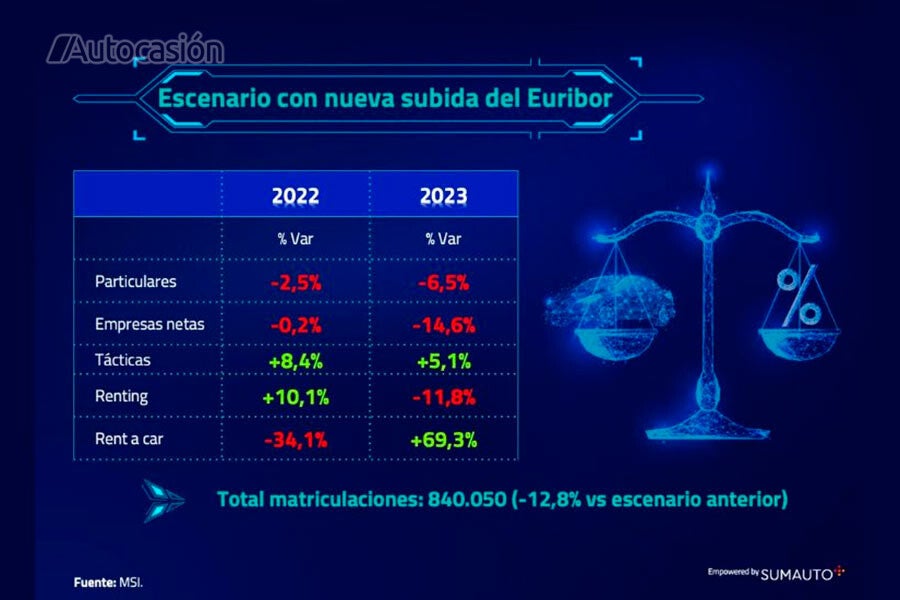
The stock would stop flowing to individuals to go to tactical and rent-a-car registrations, with growth of 5% and 69%, respectively.
The increase in the cost of money in a context of inflation fully affects registrations. Thus, a hypothetical rise in the 3-month Euribor to 2% from the current 1.7% would drag down annual sales of new vehicles by 12.8%, according to MSI data for Sumauto, a specialist in vertical automotive portals, published with reason for the celebration today in Madrid of Expo Ganvam.
The report, which is based on the Euribor as it is a reference index, calculates that a rise of three basis points would worsen car sales to the private channel by 15%, at a time of rising mortgage prices and rising energy bills. In fact, according to Google data for Sumauto, searches related to electricity and gas shot up 108% in the last year, the ones that grew the most, while those for new and used vehicles fell 14% and 15%, respectively.
In addition, a rise in the 3-month Euribor to 2% in a current context of supply recovery (stock) and cooling demand (sales) would cause an increase in the transfer of cars from the new market to the used market. This would explain why tactical registrations, which include self-registered and zero-kilometre vehicles, increased by 5.1% next year.
A similar situation would occur with car rentals, which would be one of the great “beneficiaries” of this transfer of vehicles, with a 69.3% growth in registrations in this scenario. And it is that, since the beginning of the pandemic, The shortage of vehicles motivated manufacturers to prioritize the private channel through the dealers for a matter of profitability, which meant ceasing to nurture the operators in the same proportion.
The antecedent of the first rise in interest rates
As an immediate background, the report has verified how the rise in interest rates in July plunged registrations by 17.7% in September compared to the same month of 2019 (pre-pandemic year). This caused the available stock to have to find other channels to flow, as was the case of tactical registrations or rent a car, which grew by 16% and 60.9% year-on-year, respectively.
These data corroborate how, in the current scenario, the different market players -manufacturers, dealers and rental companies- are trying to manage the stock available internally without having to resort to foreign markets. This explains that vehicle exports have fallen by almost 60% in so far this year.
In the words of Frédéric Cantaert, Commercial Director of Sumauto, “it is striking how, even with the slowdown in demand, the market is, colloquially speaking, in ‘Juan Palomo, I cook it, I eat it’ mode, that is to say , moving the existing stock transversally between channels and without resorting to alternative markets to digest the cars that are leaving the factory but no longer find a buyer so easily”.

