

For some time we have been talking about the fact that Spain is the tail of Europe in terms of electric sales. Being one of the largest producers and also an important market by volume, this type of technology is not advancing at the desired level. The main reasons are the lack of infrastructure and also the high price of these vehicles. That has been shown to be directly related to purchasing power of the people, since they are less accepted in countries with lower incomes.
This has been reflected in the latest study of the European Association of Automobile Manufacturers (ACEA), which states that the price of electric cars remains a significant barrier for European consumers. Many cannot directly consider it and the figures are quite misleading. At a European level we see that sales of electrified vehicles (electric + plug-in hybrids) represent 21.6%. However, in more than half of the countries its share is 9% or less.
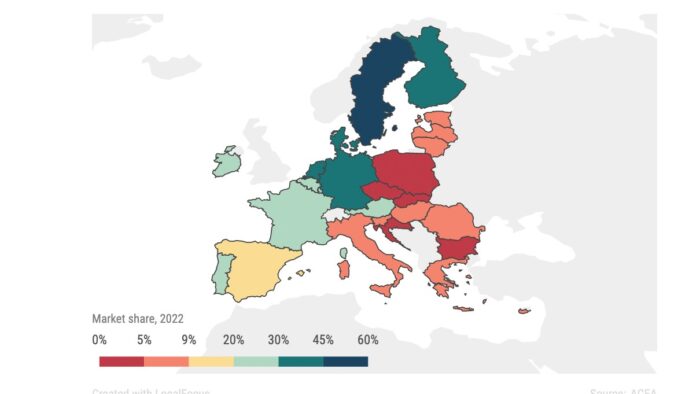
This is the case in Spain and also in other areas of central, eastern and southern Europe, such as Greece, Italy, Poland or Croatia. In some of these areas, the average annual income is below 13,000 euros net, which makes it impossible to acquire a vehicle that is usually above 40,000 euros. If we focus on the national level, here the penetration of electrified is 9.6% and we have an average income of 21,669 euros. The contrast is made by the countries of northern and western Europe, where purchasing power plays a fundamental role.
There, the electrified sales exceed 30%, some even far above. In Sweden, 56.1% is reached thanks to the fact that their income is 35,486 euros on average. The same happens in Denmark, Finland or the Netherlands. It is clear that a gap in electrification is opening up in Europe and access to charging infrastructure is only helping to make it bigger. From ACEA they believe that they are necessary more purchase incentives and speed up installation of charging points so that the transition is fair throughout Europe.
Source: ACEA

