

Alfa Romeo is one of the brands that most is taking time to embrace electrification. The reasons are merely circumstantial, since after entering Stellantis they were left with a rather reduced range of models and are currently in full product offensive. We are going to review all Alfa Romeo hybrid cars, a list that for the moment is short, but that will grow in the coming years. Everything is at stake on a model that is the spearhead: the Tonale.
In the Alfa Romeo Giulia and Stelvio a recent update has been carried out and the electrification has still not arrived. Therefore, the only option to have an ECO or ZERO label is with the most recent model in the range, with the only one that has a platform taken from Stellantis. It only has it in two very different formats and quite complementary to each other. There is no conventional hybridization, the Tonale is offered with Mild Hybrid technology or with a plug-in hybrid powertrain.
Microhybrids (MHEV)
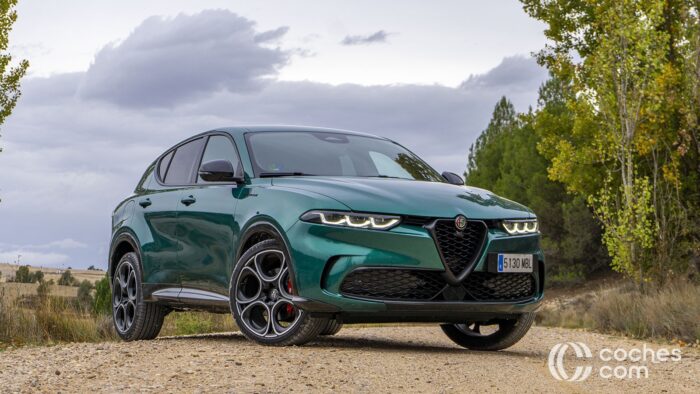
In the Alfa Romeo Tonale range there are two micro-hybrid versions (MHEV) that get the DGT ECO label thanks to a 48V mild hybrid system. It helps to reduce their consumption and emissions, giving the customer a more than correct option for all types of uses.
130 MHEV
It is the access version of the Tonale and has a 1.5-liter four-cylinder turbo gasoline engine. Its features include Miller cycle operation and a high compression ratio of 12.5:1. Thanks to this, they get 130 hp and 240 Nm of torque, always linked to a seven-speed dual-clutch automatic transmission. Although the part of the electrification in the SUV is more interesting.
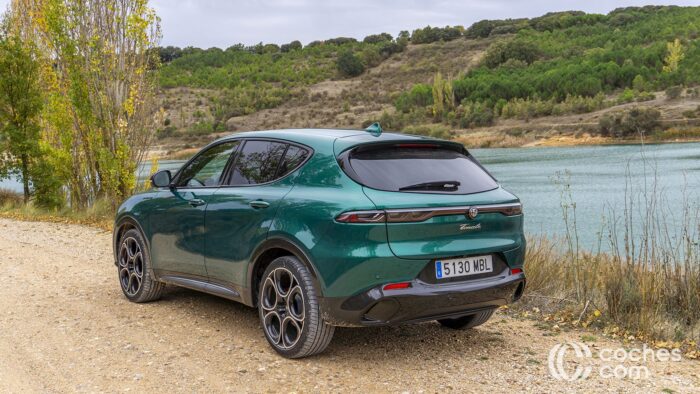
Enter the electric motor P2 of 48 volt, which has 15 kW and 55 Nm. It is capable of driving the wheels even with the internal combustion engine off when driving at low speeds, during parking or at cruising speeds. As usual with this technology, the system has a belt start generator (BSG) for electric starting and for energy regeneration.
160 VGT MHEV
That same electrical part appears in version 160 VGT MHEV. It has the same 48 V engine with that operation that helps reduce consumption and emissions, although there is a substantial difference in the gasoline block. In this case, the 1.5-liter four-cylinder engine uses VGT technology (Variable-Geometry Turbo) to increase power.
With the variable geometry turbo, a direct injection of gasoline at 350 bars and some tweaks; the tone reaches up to 160 hp and offers very interesting features. In these Alfa Romeo Mild Hybrid examples there are details such as the “Silent Start” (electric start), the “e-Boosting” (support of the electric to the gasoline engine to improve performance) or an exemplary “energy recovery” through the braking or cruising.
plug-in hybrid
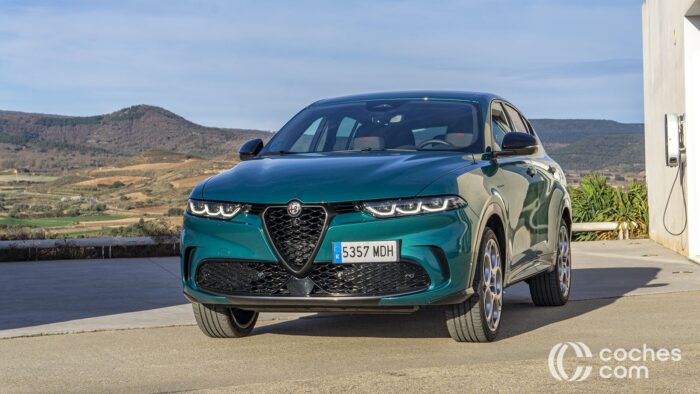
The range is also completed with the Tonale Q4, which is the plug-in hybrid version of the model and the the only one that gets the ZERO label of the DGT. It is the true top of the range for its power level, but it also wants to boast all-wheel drive as a differential factor. On a technical level, it combines the heat engine 1.3 MultiAir turbo four-cylinder (at the front) together with a 90 kW electric motor (at the rear axle).
With the combination of both, four-wheel drive is achieved and that 280 hp power level. To complete the set is the nickel-manganese-cobalt battery with 15.5 kWh capacity. It is the one that allows you to travel up to 60 kilometers only with electricity. In urban environments that electric autonomy could reach 80 kilometers. For charging, it can be done in a conventional socket (5:30h) or in a 7.4 kW Wallbox (2:30h)
It is also interesting that the Alfa Romeo Tonale plug-in hybrid has some specific driving modes. With Advance Efficiency, it is forced to take advantage of the energy from the battery and the combustion engine only starts if the battery runs out or there is a lot of power demand. There is an e-Save to reserve that energy for later. With the Natural, both worlds (electrification and combustion) are combined in an exemplary way, while the Dynamic uses more gasoline to have a sporty behavior.
Photo gallery:
 1/32Photos
