

With so many SUVs, it is logical that some of these models become classics. The original Cayenne, we could consider it at this point, one as such. For the same reason, Porsche took two first-generation units on an expedition of nearly 3,500 kilometers through the beautiful, but at the same time rugged roads of the southern continent. A 2009 Cayenne and a 2010 Cayenne were the ones indicated for the tour.
Before embarking on the trip along the Austral highway from Puerto Montt (Chile) to Ushuaia (Argentina), the two Porsche Cayennes were equipped with some accessories from Porsche Tequipment; including luggage racks and roof tent, rails, offroad wheels, side steps and rear underbody skid plates. Optional offroad tires were also fitted to both vehicles.
The journey, narrated by the Porsche team
Although the final goal was to reach the southernmost city of the American continent, the journey decided to begin its adventure to the east to visit Bariloche, the Argentine town that is closely linked to the history of Patagonia itself. After leaving Puerto Montt the road skirts Llanquihue, the first of many lakes of different colors that separate both countries. A few minutes away, a stopover to listen to the roars of the Petrohue waterfalls and enjoy its blue waters under the silent watchful eye of the 2,652 meter high sugar cone that is the Osorno volcano.
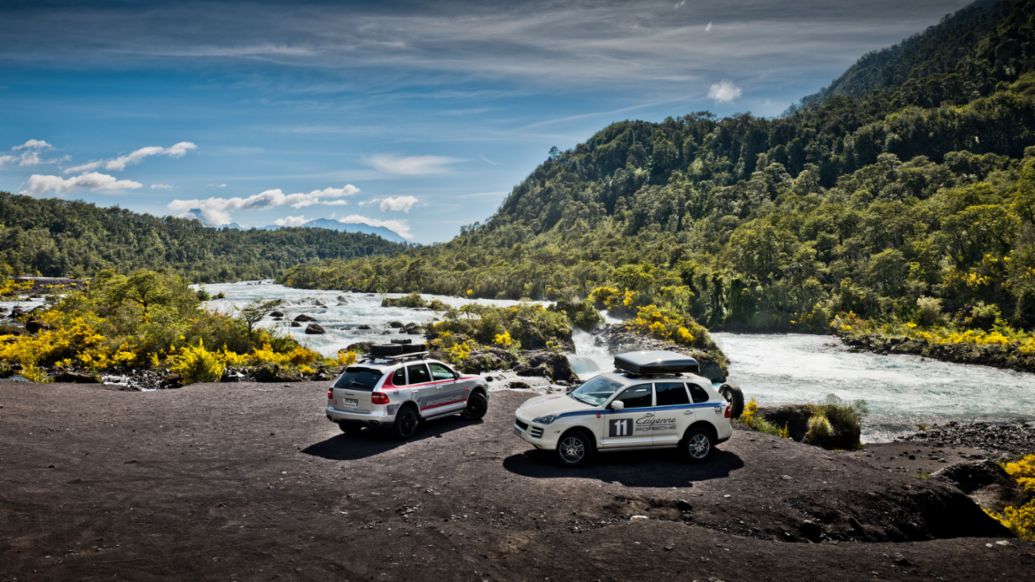
The curves of the road in the Andes mountain range and the natural landscapes offered by the Puyehue national parks, Nahuel Huapi and Perito Moreno make this an incomparable start to the trip, not only for the crew members but also for the two Cayennes, who, despite having been in use for more than 12 years, feel in their environment. The 290 Hp of power offered by its 3.6-liter V6 engines are still enough to overcome these types of roads.
Twenty-four hours are not enough to get to know the “Argentine Switzerland” in depth, but at least they serve to enjoy the Nahuel Huapi lake, see the Catedral hill in the background, eat handmade chocolates and the famous alfajores with dulce de leche. A glass of red wine is another must, as is a Patagonian lamb roast.
Back in Puerto Montt, the expedition is greeted once again by that leaden sky, the product of the constant evaporation of the Pacific waters that face the cold temperatures of the Andes. With this panorama, some rain and the squawking of the seagulls that constantly fish in the port, the two Cayennes take National Route 7, also called the Austral highway, one of the most beautiful in the world due to the privileged geography it crosses.
Less than 50 kilometers away, the Cayennes arrive at La Arena, where they are transported by ferry to cross the Reloncavi estuary and continue south. Snowy mountains and gray fjords are present all along the way. In Cholgo, the Cayenne get back on a new ferry that will transport them to Pillán. There are three hours in a serene lullaby accompanied by icy winds despite the summer.
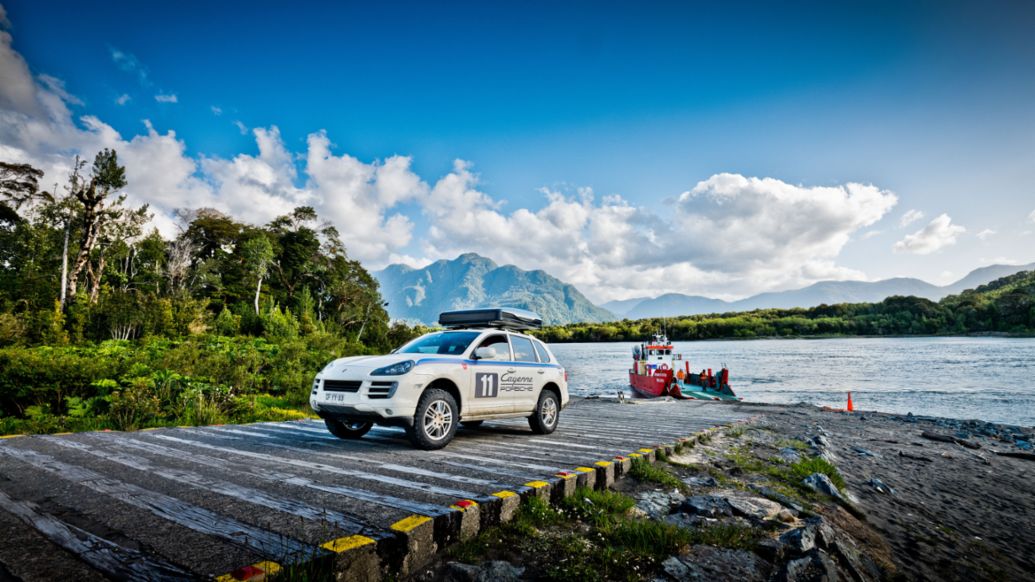
Another stretch avoiding the highway and the SUVs board a new ferry at the mouth of the Reñihué River. A few minutes later, the Cayennes roll again on Route 7. The shadows caused by the 2,450-meter Michinmahuida volcano accompany them in the last kilometers before reaching Chaitén, the place chosen to spend the night.
In Chaitén several winding and cold rivers converge where salmon and trout abound. They extend through green valleys and end in large sandbars on the rugged and grayish coast of the Pacific.. The city, hit by the eruption of the volcano that bears the same name in May 2008, today houses some 700 inhabitants and has lost the vigor it had when it had more than 5,000 inhabitants before the avalanche of mud and lava that buried it.
Leaving Chaitén, the offroad tires of the Cayennes make the gravel of the Austral road crunch. The white top of a new volcano, the Corcovado, it rises 2,300 meters and silently witnesses the passing of the Stuttgart sports cars. About 45 kilometers from Chaitén, the emerald green waters of Lake Yelcho appear. Its 116 kilometers of surface force the Austral highway to make its way through the west.
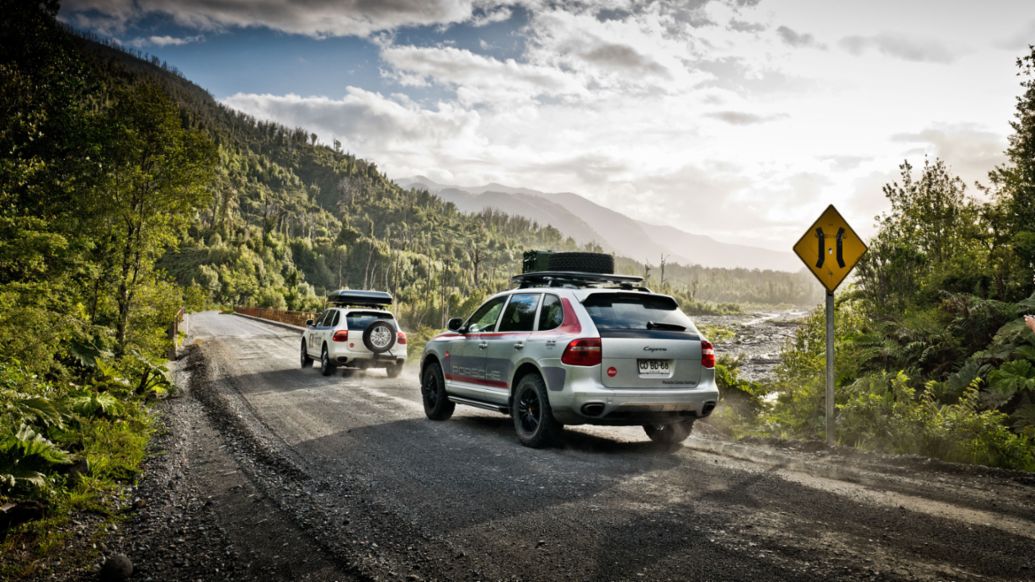
The crossing of the Yelcho river must be avoided by means of an old suspension bridge whose deteriorated concrete columns support the rusty cables of a passage whose width is barely more than that of a truck. Crossing the dark waters ends civilization. The expedition enters into a true adventure where nature marks the times.
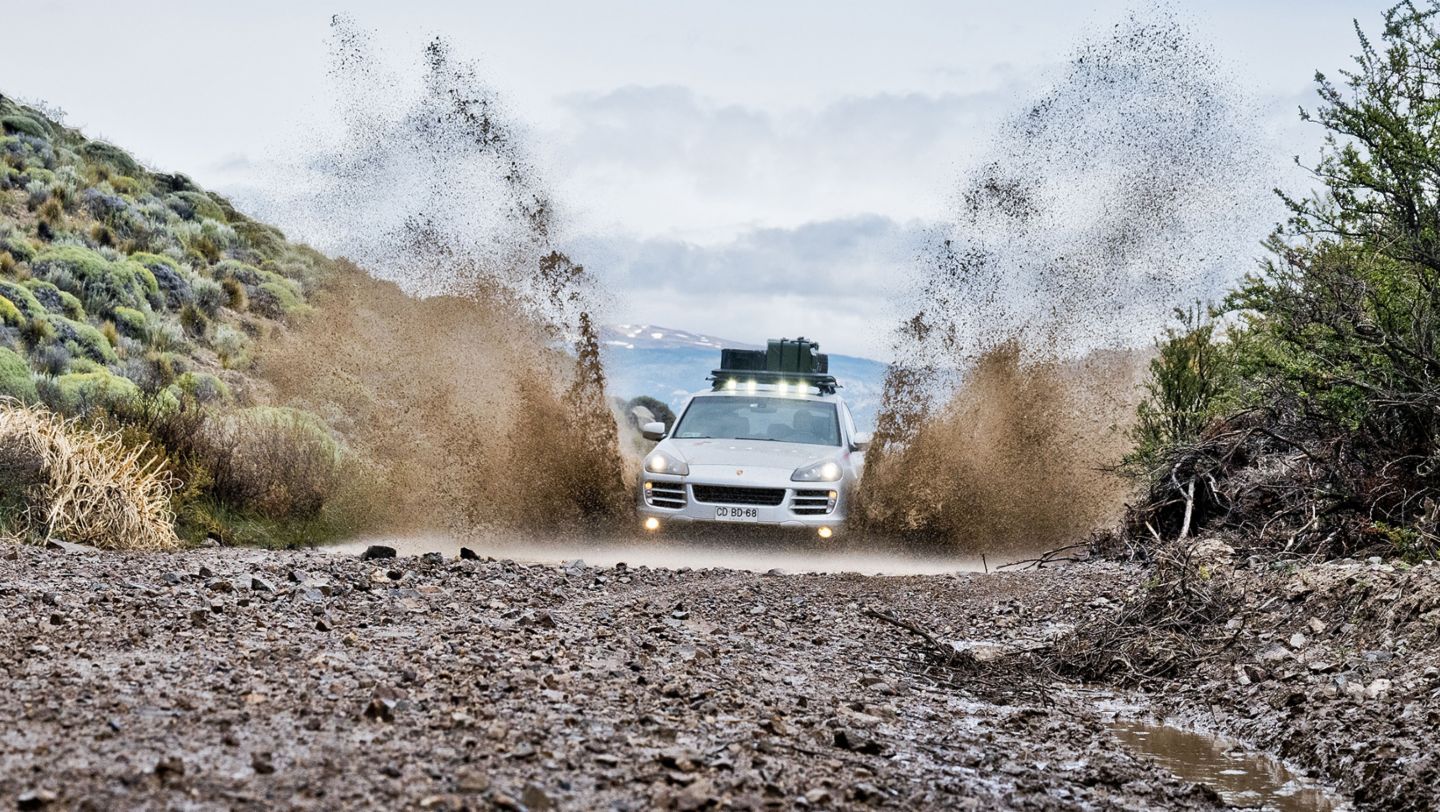
Muddy sections that make the wheels slip, holes in many parts of the road and endless gravel make this section a kind of southern rally. Cayennes don’t complain. On the contrary, they remind us that between 2006 and 2008 they tamed the more than 10,000 kilometers of the Transsyberia Rally from Berlin to Lake Baikal, in Russia.
The pace of life in this Pacific region is known to be slow. Its few inhabitants say well that: ‟He who hurries in Patagonia wastes his time”. So the expedition decides to make a detour west to the Piti-Palena Fjord while others enjoy fishing the lakes, rafting the rivers, watching dolphins and whales, kayaking the bays, horseback riding the valleys. or are heated in hot springs. Piti-Palena is a good place to savor a thick and creamy clam chowder or eat some strips of fried fish similar to spaghetti that are accompanied by French fries. It is also a suitable place to set up the Porsche Tequipment roof tent on the roof of one of the Cayennes and sleep under the stars in uninterrupted silence.
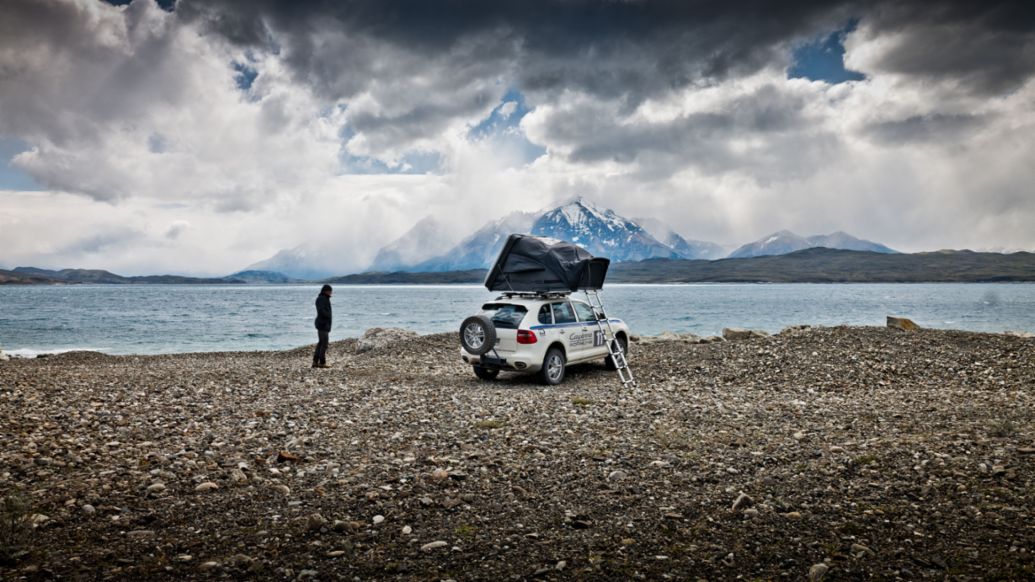
The next day, the Cayennes again join Route 7 and continue south. The thick vegetation does not change and the stones on the road continue to punish the underside of the cars. The arrival to the Cisnes river valley brings a temporary relief with the reappearance of the pavement. Closer and closer to Tierra del Fuego, the expedition decides to spend the night in Coyhaique, a city that with almost 60,000 inhabitants seems like a metropolis in the middle of nowhere.
The road rises again through the Andes and the gravel hits the Porsche Tequipment skid plates and running boards again that were installed in the Cayenne. The spectacular lakes and rivers of glacial origin also reappear with their greenish or bluish waters. A long section that reaches Cochrane.
After a detour to the Tortel fjord, the expedition heads south, crossing the border between Chile and Argentina. The majestic Cerro Torre appears imposing with its 3,133 meters high and its white peaks. The trip continues for hours and hours with landscapes so majestic that they end up being monotonous.
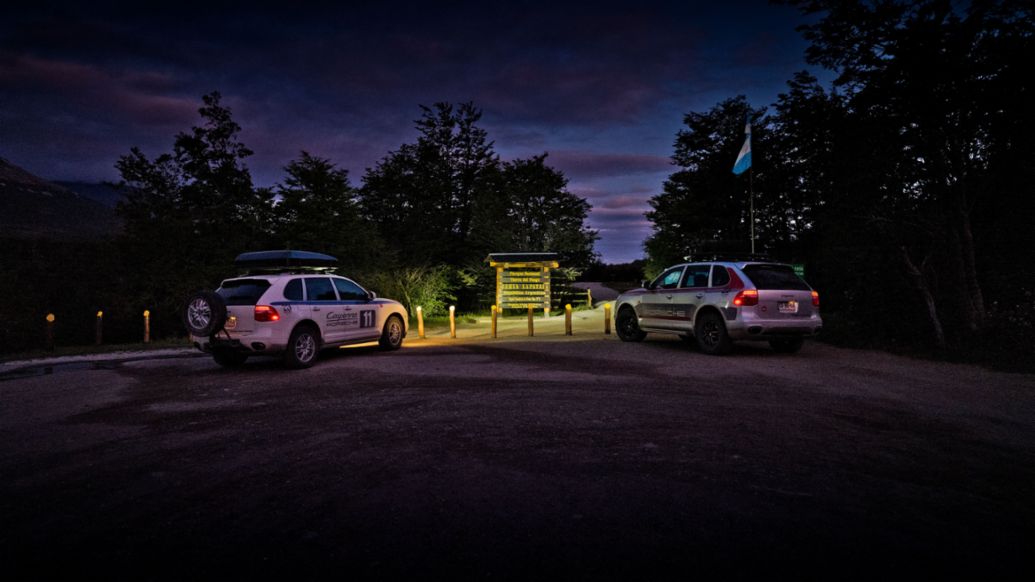
Suddenly, the Perito Moreno glacier appears and ends the monotony. Its white and bluish ice, five kilometers in front and up to 60 meters high, rests in the southern area of Lake Argentino, in Los Glaciares National Park. The creak of the glacier and the collapse of one of its ice sheets remind us of global warming.
With that thought, the expedition continues through the vast Argentine pampas, which in that area offer a lunar landscape. Stretches of gravel and pavement bring the two Cayennes back to Torres del Paine National Park in Chile. Seeing the mountains rise more than 3,000 meters above the frozen lakes, it is immediately easy to understand why the native Tehuelche called them “Towers of Blue Sky”. Its granite peaks are saturated with colors: gray, ochre, orange-red, ivory, silver, and brilliant white.
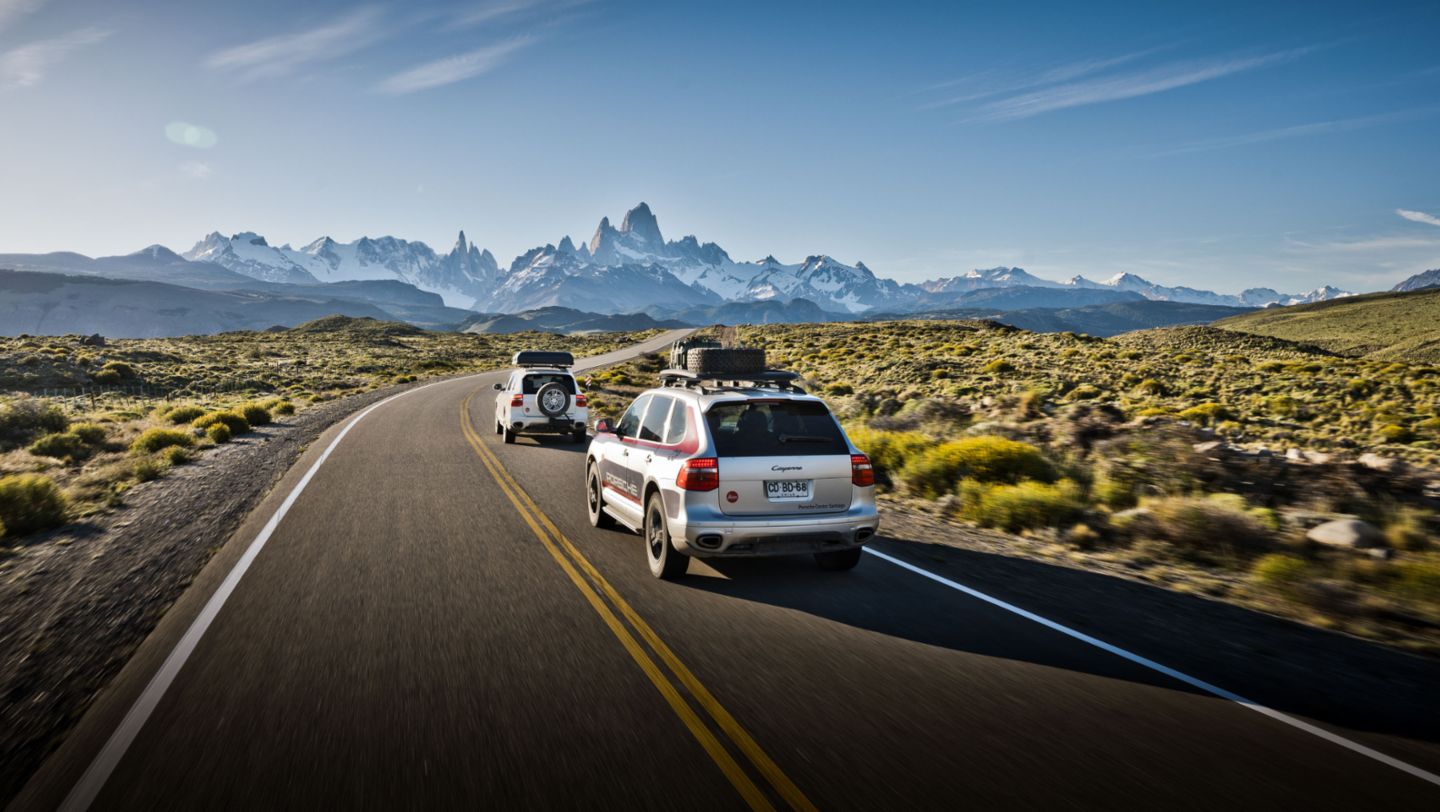
The “torres” are left behind and the Cayenne go in search of Puerto Natales along National Route 9. A short rest to continue towards Punta Arenas, in the Strait of Magellan. The road stretches almost endlessly through gently rolling terrain.
Suddenly, the Cabeza de Mar lagoon appears, a first greeting from the Atlantic Ocean. A channel in the north of the large body of water connects to the east and leads to the smaller Laguna Verdana, which is connected to the Strait of Magellan by a passage approximately three kilometers long. This is the passage of approximately 600 kilometers between the Atlantic and the Pacific that the Portuguese navigator Ferdinand Magellan discovered in 1520.
A few kilometers further south, the blades of a wind turbine connected to several industrial plants can be seen in motion. This is the Haru Onu e-fuels pilot plant, where Porsche and several partners are developing the synthetic fuel that, together with electric cars, is part of its decarbonization strategy.
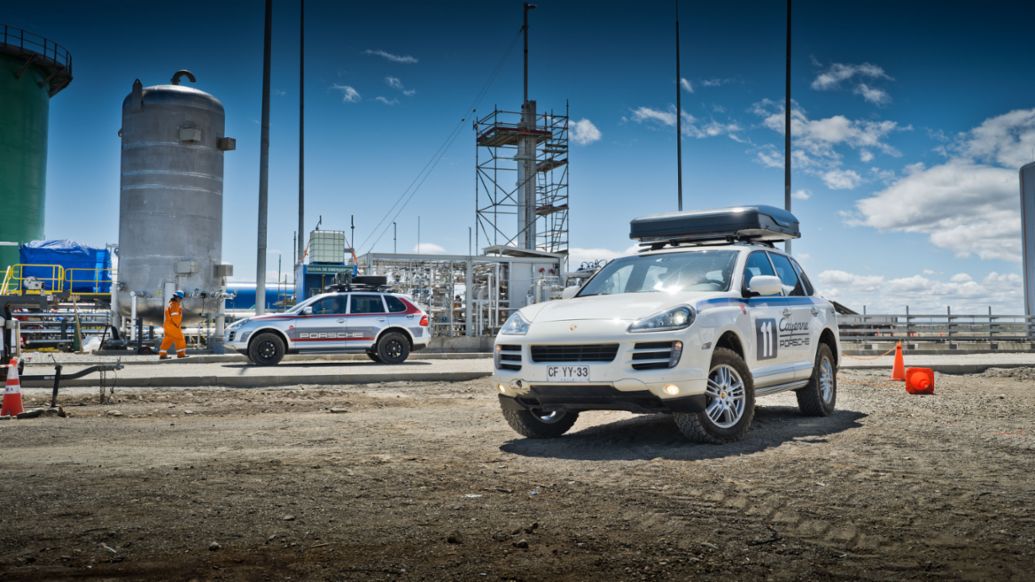
Leaving the Haru Oni plant and taking the ferry that connects Punta Arenas with Porvenir through the Strait of Magellan, the smell of oil from the ship’s engines quickly makes it clear that not only cars must seek alternative forms of propulsion. And while it’s not currently feasible to build ships or planes with electric motors, synthetic fuels can be a great solution for those industries as well.
The Cayennes get off the ferry and begin to cover the last leg of their adventure that will make them cross the border into Argentina again and go to the city that claims the title of being the southernmost in the American continent, whose sign at the entrance welcomes you with a sign that reminds you where you have arrived: “USHUAIA, end of the world”.

