

21 photos
 Miguel Garcia
May 15, 2023
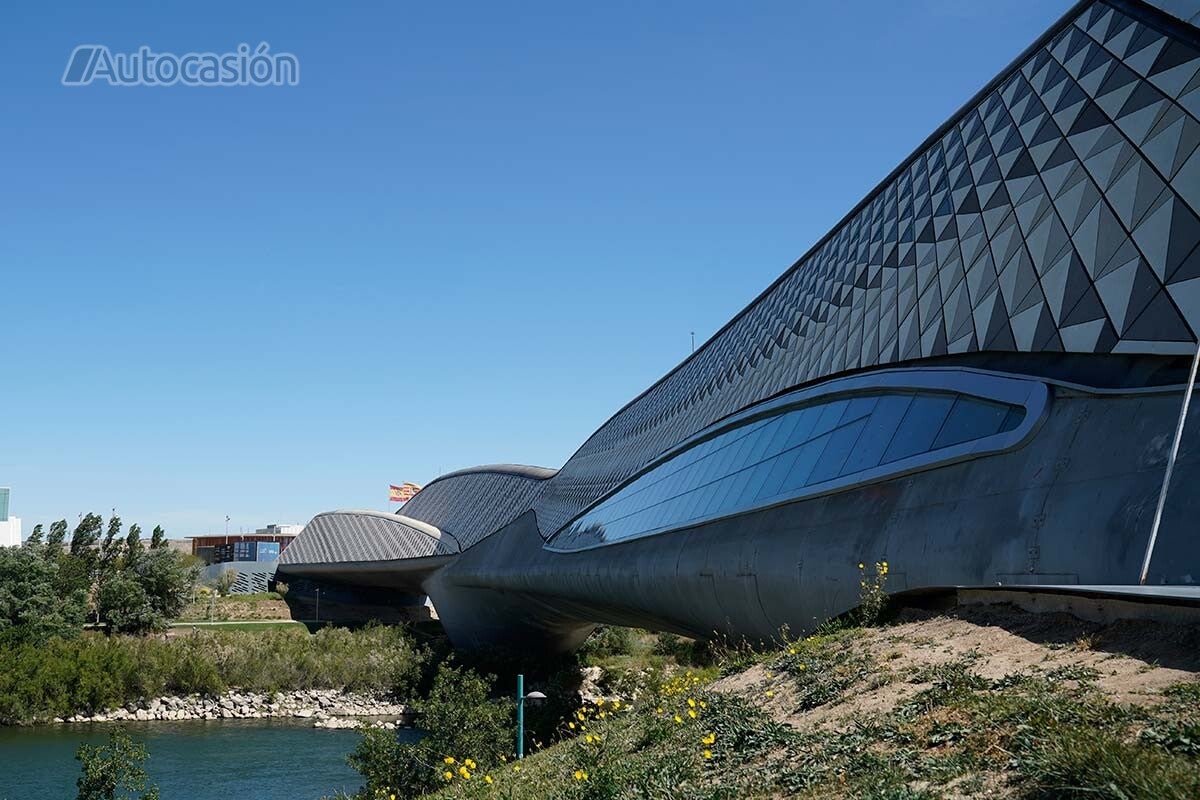
A car museum on a bridge? In Zaragoza, you have it. It’s called Mobility City and, at the moment we visited it, its temporary exhibition “The Superclasses that changed history” is ephemeral, but a must for a fan.
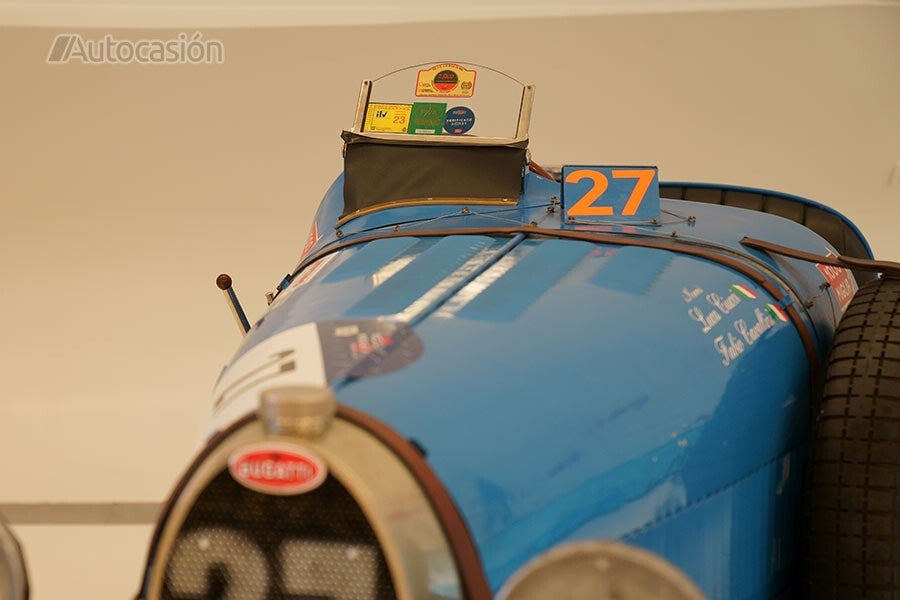
I confess it The car that has impressed me the most in Mobility City is a Bugatti. You would say that it is normal, because at the time the Bugatti Veyron that is exhibited there was the fastest production car in the world, with a top speed of more than 400 km/h. Well no, you are wrong. At his side rests after many gallops a Bugatti T37-A, the evolution of the legendary Bugatti 35, the Grand Prix car that was a hit in the 1920s. Its 90 horsepower may seem few to you, but almost a hundred years have passed since then. Back then, the roads were nothing more than dusty or cobblestone roads at best. The brakes were gigantic, but drum-type, and I can attest to how little stopping they did. And I have been able to see how much that car can run with a 1.5 engine and compressor. Perhaps these characteristics that you can find today in a Golf TSI may sound like little -unlike its free exhausts-, but think that current Formula One also has similar limitations.
Personally, I was blown away by the plate that the T37 wore for having recently competed in the legendary and reborn Mille Miglia and, above all, the sticker on the tiny visor that acts as a windshield, the one that says that the ITV is valid until 2023. Its enamel logo looked immaculate, fair the opposite of the same emblem on the Veyron, which had lost its colorperhaps from rubbing it so much to remove mosquitoes.
21 photos
However, this wants to be a sample of mobility, of evolution, of history. One of the very long walls of this linear sample makes a tour that starts at the wheel and goes through the main artifacts that humanity has invented to move further, faster, and more comfortably. Obviously, these are only photographs. On the other hand, following this scheme of projection towards the future, bicycles can be seen as modern, as galactic, without a wheel hub, as if the wheels were floating. It is the same invention with which the Swiss Sbarro filled car shows for years with delirious designs. Continuing towards the future, a model of a drone for transporting people occupies the place where the authentic drone was during the inaugural visit of King Felipe VI, together with a projection of the Hyperloop project.
Several electric cars emerge in Mobility. They are mostly concepts, donated by car manufacturers, suppliers or engineering companies. Two of them are two technical demonstrators, one provided by BMW, the other by Stellantis -logically, the Opel e-Corsa is produced in Zaragoza-, with which it is clear that the electric car is nothing but a battery on which a car is built.
A car exhibition that you cannot miss
21 photos
I have to go back to the paid part of this exhibition, the collection of cars of all time. It is not important for numerous, but for select. There you can show off with your friends. You will be able to explain that the Dino GT was made in the Ferrari factory, but that it was not a Ferrari. Or yes, because it was the work of Alfredo Ferrari: Alfredino, Dino. But of course, even if it was the creation of Enzo’s son, how was he going to allow a car that did not have a V12 engine to be called Ferrari, but a “small” V6? If we go back to the F-1 references, Ferraris are like that today too.
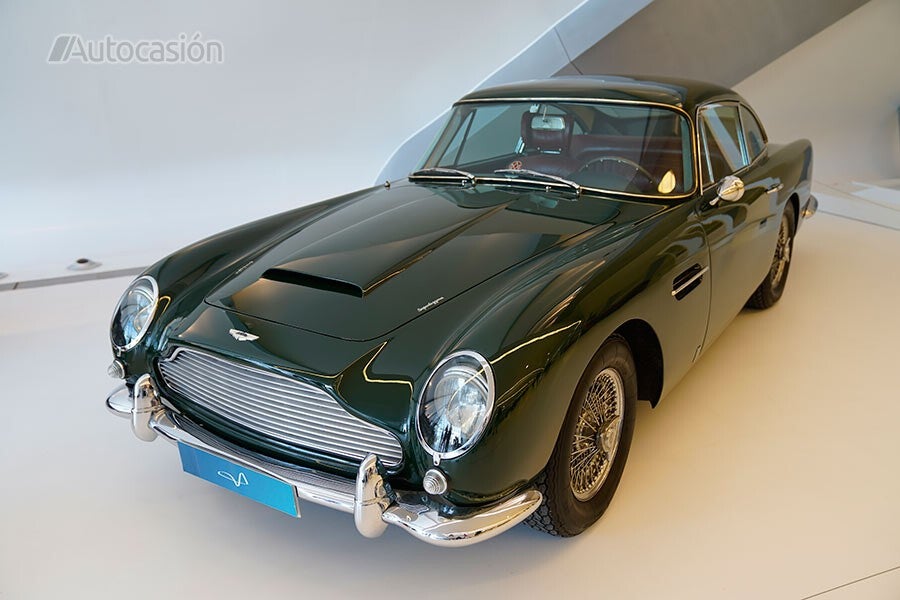
When your companions read that the Aston Martin was Bond’s car -and now they know the Aston Martin brand from Fernando Alonso- you will be able to tell that the important thing is two small initials on the hood: Superleggera. And there it depends on you, how you count that, Before tuning, the rich in the mid-20th century had coachbuilders dress up their cars. And that in Italy, the Touring company created a frame of super-thin steel tubes as a structure to fix aerodynamic shapes made of aluminum. Its aesthetics and its lightness guaranteed the success of the company for decades, bodywork for many car brands.
It may interest you: Car bodybuilders, in danger of extinction
You will be able to explain that the Borrani spoke wheels that the Aston DB5 sports are still manufactured and that famous Auto Union drivers such as Stuck, Nuvolari or Rosemeyer were already using them long before.
Oh, they don’t know who Rosemeyer was? You will be able to show off, once again, knowing that he was one of the Verstappen from before the Second World War. Died trying to break highway speed record that Mercedes had established a few days before, at well over 400 km/h. Yes, about 90 years ago, long, long before this Veyron that we just saw….
And it was a gust of wind, not a failure of the spoked wheels, that put an end to the pursuit of automobile top speed records for years.
Manufacturers like Michelin still produce these “classic” tires today, with the shapes and tread that these classics have.
Suddenly, you see yourself explaining -because they are seen through the radios- that disc brakes were a modernity at that time. They had been used for the first time eight or nine years ago, at Le Mans, and the records were a Dunlop invention. Yes, I use a Jaguar Type D, and it blew it away. So much so that all racing cars began to use them. Then the sports. Today, even the Twingo.
You don’t know how, but you raise your head and, as if prepared for your speech, in a corner, hidden behind a Jaguar Formula E, there it is: a Jaguar Type D! Its tires read Dunlop. It has Dunlop tires. How much detail. Of course, with its central competition nut, “with hand”, specific for right or left, so that they self-tighten when turning.
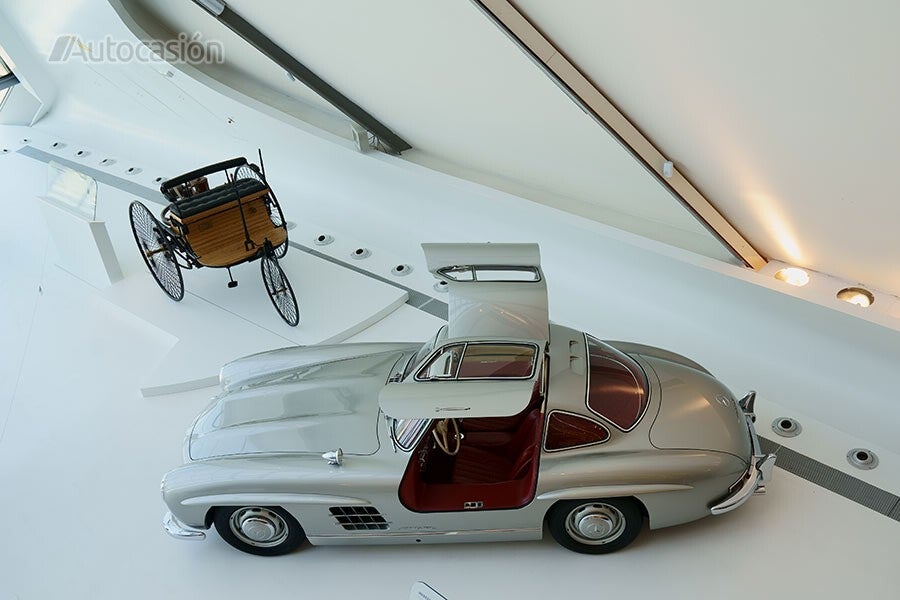
Yes, they are a handful of cars, but if you like cars, boy is it worth the visit. One of the first Daimler tricycles, “the first car”, poses next to the Mercedes 300 SL, with its gull-wing doors. Ford’s “first car” is also shown, along with a 1:1 model of a Ford car designed for video games. You will be able to see the Porsche 356 that was born from a Beetle or the Hispano Suiza model that Alfonso XIII allowed to be named after him.
21 photos
I have not finished telling it, but the Bugatti that impressed me the most was not the Veyron, nor the 37, but an immaculate Baby I, a replica of the Bugatti 35 on a child’s scale. I had never seen one that looked brand new. No pedals, its propulsion was electric, and it reminds us that it all started with the electric car. The electric vehicle was not only a taxi, for quite some time it was more popular than that car that was filling the streets with explosions and smoke, which only had two advantages: a lot of energy with little weight, and abundant and cheap oil, which came out with just drill into ground. This last advantage is being lost, and noise and fumes are doing the rest for the change in mobility.
Who pays for this party? For the collection there are tickets at 10 euros, a visit that is completed with driving simulators and a virtual reality experience. Another part of the visit is free. There are vehicles donated by a specific brand, such as the concept that gives rise to the new Volvo EX90 -already out of production for a full year-, or the Hyundai Nexo with a hydrogen fuel cell, which has been on sale for some time. Large suppliers such as Antolin, the world’s leading manufacturer of car interiors, based in Burgos, explain a future with materials such as cork, bamboo or stone. Those who just want to walk around without paying, will be able to enjoy living architecture: how the semi-open footbridge created by the late world-famous architect Zaha Hadid, the “Bridge Pavilion” of the Water Expo 2008, has been converted by the Fundación Ibercaja into a futuristic space with coatings sheltered from water and the north wind.
Mobility City does not have its own funds, but most of the copies are temporary assignments (the current one, until June, except for extensions). Which does not take away relevance or relevance to the vehicles that have been gathered here. A living museum, but with such an open theme that, with selected discrete pieces, it can turn Mobility City into an infinite museum, as its logo seems to suggest. The first installment, we have already devoured him.

