

Background
Toyota’s Full Size Pick Up launches a generation, the 3rd that was presented at the end of 2021 as a 2022 model and that is assembled at the Toyota plant in San Antonio Texas.
A little history…
The first generation was born in 1999 -a few years before the arrival of Toyota in the Mexican market- and it was known under the code names: XK30 and XK40 and there were two engines available, a V6 and a V8, it was marketed between the years 2000 to 2006.

Toyota Tundra 1999 XK30
The second generation was really long-lived by current industry standards, it was introduced in 2007 and was available until 2021, it was known under the code name XK50 and as in the previous generation V6 and V8 engines were available.

2019 Toyota Tundra XK50
The third generation arrived in Mexico at the end of 2022, under the code name XK70 and following the trend of the Japanese manufacturer in the Mexican market, there will only be hybrid mechanics availablea fact that I consider a great success of the brand for all the positive implications in environmental issues and also fiscally speaking.
Toyota Tundra 2023: Design and Dimensions
The third generation offers us an angular design, very imposing and large, the dimensions are generous.
Undoubtedly the most imposing and intimidating aspect is the huge front grill, square, rough and that makes a lot of impact due to its appearance.
The height in relation to the floor means that we have to resort to the many interior “handles” to get on and off it, and inside everything is “Full Size” starting with the touch screen, but we will talk about it in the relevant section.

- Length: 5,933mm
- Height: 1,956mm
- Width: 2,032mm
- Wheelbase: 3,701mm
- Weight: 2,524 kg (Approx)
- Towing capacity: 5,000 kg
2023 Toyota Tundra: Specifications
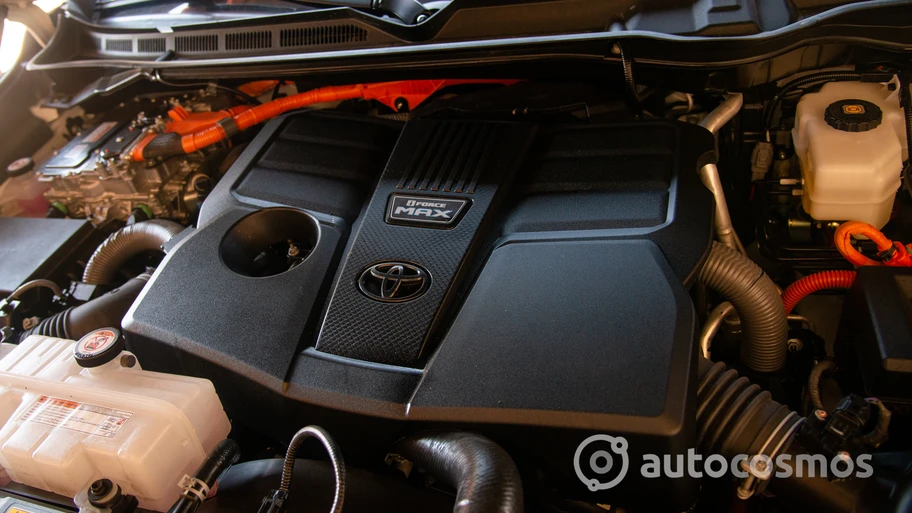
Toyota’s large Pick Up returns to Mexico with two versions: Limited and Platinum. Both, with the same hybrid engine powered by i-FORCE MAX technology
Specifications
- 3.5-liter twin-turbo V6 engine
- Power: 437 HP at 5,200 rpm
- Torque: 585 lb-ft between 2,400 to 3,600 rpm
- NiMH (Nickel Metal Hydride) battery of 1.87 kWh, 6.5Ah and 288 V
- Transmission: 10-speed automatic
- Traction: 4X4 (4WD)
2023 Toyota Tundra: Interior
Like everything in the Tundra, the interior is also huge, the seats are comfortable and offer many power adjustments, the visibility – thanks to the height – is very good, and also the exterior mirrors are huge.

Lots of storage is in the center console, plus all the transmission controls, drive modes and traction selector, second row is a HUGE space that fits three adults, rear amenities aren’t as many as in the main row, but we have a connectivity option only for device charging.
Toyota Tundra 2023: Infotainment
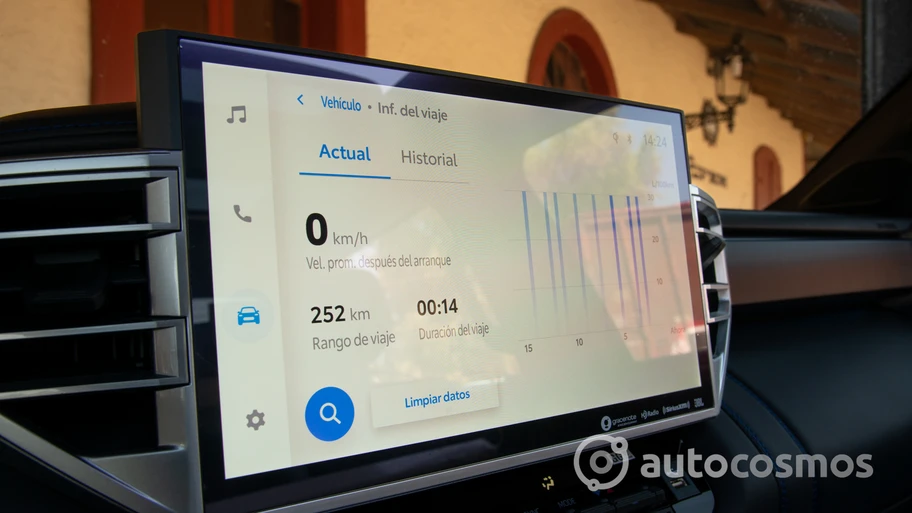
The central screen is touch operated and is truly large -large dimensions are a constant in the Tundra- and it measures 14 inches, the instrument cluster is also completely virtual and is 12.3 inches fully configurable.
Pairing with devices can be done in the traditional way with a cable or via bluetooth, and the phone can be placed on the wireless charger that is in an easily accessible compartment.
- Wireless Android Auto and Apple CarPlay
- Dual Bluetooth for two simultaneous phones
- 14-inch JBL HD touch screen
- 12.3-inch instrument cluster
- Dual Bluetooth for two simultaneous phones.
- usb connectors
- Wireless charger
2023 Toyota Tundra: Safety
In this section it fully complies and also offers many driver assists -called ADAS- which are now in vogue, fortunately in the automotive industry.

- 8 airbags
- Anti-lock Braking System (ABS)
- Electronic Brake-force Distribution (EBD)
- Brake Assist (BA)
- Traction Control (TRAC)
- Stability Control (VSC) + (EPS)
Toyota Tundra 2023: Driver Assistance (ADAS)
- Pre-Collision System (PCS)
- Lane Keeping Assist with Steering Assist (LDA) w/SA
- Lane Tracing Assist (LTA)
- Automatic High Beam (AHB) System
- Dynamic Radar Cruise Control (DRCC)
- Trailer Sway Control (TSC)
2023 Toyota Tundra: Handling

One might think that a vehicle with that immense mass is difficult to drive, although maneuvering in small parking lots is a bit complicated and its design is designed for the great Texan plains and its ideal habitat is wide open areas… I can’t imagine a Tundra through the narrow streets of Guanajuato, Taxco, Rome or Paris…
Thanks to the size of the exterior mirrors and the help of the 360 camera -which at first confuses more than provides help- it is possible to maneuver without problems, the front camera is of great help in approaches as the hood is so large and so high that it is impossible to detect an object, person or pet that is within a meter and a half of the pick up, and this assistance added to the radar is a great help and thanks to the hybrid powertrain we have endless, linear and responsive acceleration throughout the rev bandAlthough there is no sporting vocation on asphalt, you can drive with high averages on paved roads.

The 4X4 capability is also notable, Although the extreme 4X4 is not designed for vehicles of these dimensions, it can, but its size is a great limitation. The load capacity is around half a ton and the towing capacity exceeds five tons, that is, ideal for moving a boat, a motorcycle trailer or a racing car.
The handling is completely predictive and comfortable, the suspension scheme of double wishbones front and rear MultiLink provides comfort in the cabin and a lot of control in handling.
Conclusion
Tundra is a vehicle with roots in its consumers, it will surely be a commercial success -as was its predecessor- and today, having hybrid mechanics, it has many more tax canonies and in addition to being a capable vehicle for heavy work, today it becomes an interesting tax instrument.

