

The second season of ‘Operation Black Tide’ already on Prime Video and in it we meet again with the disturbing character of Joao. The drug trafficker will travel to Galicia to discover that he has passed through with his merchandise and he will not hesitate to use his worst arts to get what he wants, yes, without getting his hands dirty. Bruno Gagliasso is the Brazilian actor who gives life to the criminal and, in full promotion of the series, receives us in a cafeteria in Madrid to tell us about his recent work in Spain, his love for our country, his projects and his fight for different causes.
Gagliasso is very close and smiling as he tells How did you get the role of Joao and what led you to accept it?. “They called me when I was shooting ‘Santo’ to do an episode, I read it and I loved it because it was a true story,” she explains. As he himself recounts, the Prime Video series was his second job in Spain. Before, he had already made himself known here with ‘Santo’, a fast-paced Netflix thriller that takes place between Spain and Brazil and in which he plays a very complex character.
It is no coincidence that throughout his long career, complexity is a common feature in his characters because he confesses to us that he does not like to “do the obvious or what is expected of him”. “I like strong characters. If there’s something that doesn’t do me good as a human being, or that doesn’t make me think, there’s no reason to do it. I’m not going to do the typical thing, I don’t want to,” he adds. He expresses himself very clearly and makes himself understood despite doing it as he himself says “in portuñol”. Language is not a barrier when it comes to speaking passionately about his profession.
From the conversation it is clear that the interpretation has been a balm in his life. He discovered his vocation because as a child he was very restless and “he only stayed calm in the theater, in the movies or in front of the television.” This is how his interest was born, which led him to start studying and later to become a professional. Brazilian soap operas were his school and it is something he likes to show offIn fact, he has participated in two that received an International Emmy: “In Brazil we are the best at making soap operas, they are very good and very powerful. They are a great school because 30 scenes are made a day and many have important recognitions.” The actor is a star in Brazil, who is recognized on the street after having entered millions of homes with his characters on television.
His international leap arrives in 2018 when he signed a contract with Netflix for projects as an actor and also as a producer. In fact, after ‘Santo’, he is preparing a new production that he can’t talk about much but that he can’t resist commenting on because it brings together everything he likes: it’s a personal project in which he’s also going to work as a producer and is a subject of complaint about a real and very controversial character in the world of cinema. “It is a collaboration with Spanish production companies to do a project of mine and that I am also going to produce and we are going to talk about the scenes of the cinema and about ‘glamorization’. The director is Brazilian and the scriptwriter is Spanish,” he anticipates before making a effort not to tell more things.
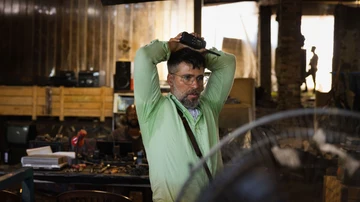
Of what Yes, he can tell more about the role of Joao that has brought him back to Spain. The drug dealer who will not let any betrayal pass. In this season of five episodes that, as we have already told here, takes another step in the plot Gagliasso makes a participation again. But despite the fact that he is a secondary character, his role is very strong and the actor is especially satisfied with one of the scenes, the hardest and most violent even though it is not explicit because as he himself tells. “The most difficult scenes are always the physical ones, the most satisfying ones are the most complicated ones. The scene that I loved doing is the scene with the prostitute in the first episode that could be violent, and it is, but without the need to yell, or do something physical.”
We have this power and we have to use it because making art is making politics.
If we talk about complex characters, we cannot ignore one of his latest works in the cinema. In ‘Marighella’, the Wagner Moura film released in 2021, he played a racist policeman under the orders of the Brazilian dictatorship. And he admits to us that he was especially harsh because of his personal situation. The actor was away from his family during filming: “I stayed in Sao Pulo, I didn’t want to be with them because my character was a racist, a fascist and I needed to have these feelings in my heart and if I were with them I would do nothing but cry “. By them he means his wife Giovanna Ewbanl and his three children, two of whom were adopted in Malawi. Even so, he did it because he says that “I knew it was important for Brazil, for the world, for me, for my children, I think that when they are older they will be proud of what I have done,” he says hopefully.
The same hope that shows when talks about Brazil and the change of government after Bolsonaro’s defeat in the elections and his departure from the country. “With the recent change of government, many things are being discovered that they have been hiding these four years. The Yanomami indigenous people were starving, they were killing people. It is a genocide. And now Bolsonaro is in the United States asking for a tourist visa to not return because he is afraid because he knows what he did. If he had not done anything, he would be in his country,” he says. Gagliasso does not hesitate to take advantage of each interview to speak about the causes in which he believes: “I think that because we are public figures we have to do things because we can influence. We have this power and we have to use it because making art is making politics.. And I need to do it because I am human and to sleep peacefully “. And he adds that” the person who does not do, is actually doing “.

