


2 photos
 Karam el Shenawy
July 21, 2023
Depending on the type of electric station and the way of charging, prices usually vary in terms of the cost of charging an electric car.
The future of the automobile will be 100% electric. This was approved a few weeks ago by the European Parliament, which established 2035 as the year in which combustion cars will cease to be produced and sold… at least as we understand them so far, since there is a window open to synthetic fuels (e-fuels) which, by the way, is still not entirely clear. But returning to electrification, the future reality is already almost present. So much so that in many markets of the Old Continent the registrations of electric cars far exceed those of combustion (if you are thinking of a Nordic country in particular, you have succeeded); while in some of its powers the market share of zero emission cars exceeds 15% and even in others it is close to 25%. In the case of Spain, our market is still in latent phase and the tail of the member countries because today the weight of electric vehicles is only 5% of the total.
It may interest you: The smallest electric cars of 2023
A panorama that does not prevent that in many corners we already hear talk about kilowatts instead of liters or consumption with spark instead of oil. It is precisely the latter on what we want to focus on because you have surely heard that one of the great advantages of the electric car is undoubtedly its cost per kilometer, determined in this case by the low price it costs a user to refill the battery compared to refueling a diesel or gasoline tank.
How much does it cost to charge an electric car?
This is the crux of the matter and the main feature why many users have decided to put an electric in their life: the low cost of refills. But all this logically depends on where you decide to recharge your vehicle since it is not the same to do it in your own home than to use public chargers. Then the great differences that exist between filling a battery or a fuel tank are reduced to a minimum. That is why it is important that you always take numbers and in the event that you also install a wallbox charger at homeyou have to take into account variables such as the price of the device itself and the installation.
How much does it cost to charge an electric car at home?

1 photos
Although there are currently not too many public charging points in our country, in this sense we are also at the tail, the vast majority of users choose to charge their electric car at home. It is the most logical solution and the one that will allow us to move on a day-to-day basis. In this sense, it is important to be aware that charging an electric car at home must be subject to what we are going to move the next day, leaving a margin for possible unforeseen events, and get rid of the idea of always having 100% of the load. With this in mind, we will also obtain a much lower price than refueling a car, logically.
Now, before entering rates, it is necessary to know in what market are we The normal thing is that you are within the free market and not in the regulated one, since currently some 16 million homes are in the first and 10.5 million in the second. To find out, you just have to look at your electricity bill. With this known, the next thing is to know what power you have contracted at home. The normal thing is that it is around between 3.5 and 5.5 kW, which means that if you have a smart charger at certain times you will be able to have between 3 and 5 kW, but instead if what you have is a normal plug, the power will be limited to 2 kW or 3.4 kW in the event that it is ‘green up’.
The next thing is to know how much you pay for the kWh of electricity and here it varies again depending not only on the type of market you are in but even within the free one, what rate you have contracted. We say this because there are super valley rates where in certain periods of time the cost per kWh can be less than 0.03 euros, while a valley rate can be around 0.09 euros and a flat rate between 0.15 and 0.25 euros. Thus, taking a 50 kWh battery like the one mounted on some Stellantis Group models such as the Peugeot e-208 and filling it to 100% (something that we repeat is not usual at home), we would obtain a cost of between 1.5 euros for a super valley, 7.5 euros for one of 15 cents and 12.5 euros for a face.
How much does it cost to charge an electric car at a charging point?
In this variable, what we are going to do is talk about charging points of alternating current (AC) where powers are normally limited to 22 kW. This implies that a 50 kWh battery like the one we were driving could be 100% full in 2 hours (the time it takes to go shopping, have dinner or watch a movie). However, there are also public AC points that have powers from the 6 kW, 7.4 and even 11 kW varying both the waiting time and the price.
At these points, it obviously depends on the service provider, but the normal thing is that you are moving between 0.20 and 0.50 euros, so filling that same electric car will cost you between 10 and 25 euros. However, there are many places here where these points offer free charges (hotels, shopping centers, cinemas, restaurants, supermarkets…). In this case, what you would have to do is take advantage of that time of use and not monopolize it so that the rotation is greater and all users of electric cars can use it. In fact, it would even be convenient for phev drivers to give preference to electric drivers.

1 photos
What is the price of charging a car at an electric station?
Although they could be agglutinated with the previous ones, we wanted to separate the direct current (DC) chargers of the alternating ones because it is the most common that we find them near the service stations (although it is not their exclusive place). These connections already go from 50 kW upwards, being especially useful when we want to charge a lot of energy in a short period of time. In fact, and as is logical, the more powerful, the less you expect, although here it must be taken into account that the ideal for an electric car is fill it up to 80% given the amount of energy that is supplied at once, thus protecting the capacity of our cells.
In this case, the price will also depend on the provider, but the rates can range between 0.30 euros, even depending on whether you have a contract with the electricity company, or 0.79 euros for what is currently the most expensive, IONITY. In these cases, the cost of charging a 50 kWh battery but be careful, at 80%, which is the usual as we tell you, that is, 40 KWh would be between 12 and 316 euros.
Where is it cheaper to charge an electric car?
Here we are going to take the generality of the countries because as far as recharging points are concerned, you have already seen that there are many variables, among which is even the fact that you are a customer or not of the electric company that provides your service or that when buying that electric car you have been granted a promotion to charge for a specific period of time at a lower cost. That being said, according to a recent study conducted by Switcher that you can see here, Spain would be located at the tail in cargo economy with an average charge cost of 18.63 euros, this being surpassed by countries such as Denmark (the first with €27.65 per charge), Germany (3rd with €19.89) or Italy (€18.89). On the other side of the scale would be the Netherlands with an average cost per load of €2.74 followed curiously by Kosovo and Georgia with €3.71 and €4.53, respectively.
How much does it cost to charge an electric car at Mercadona?
1 photos
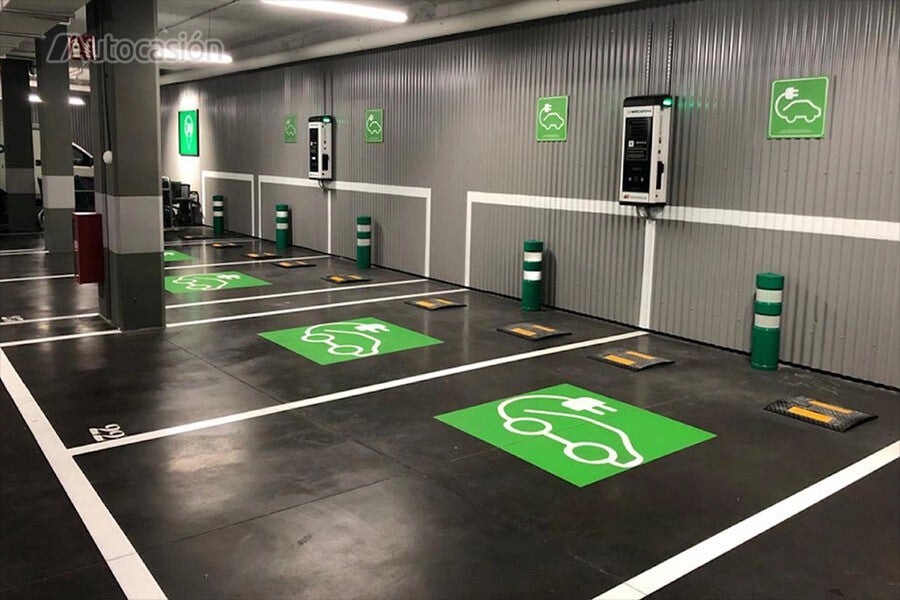
It is probably the reference supermarket for many of you and that is why recently Mercadona signed an agreement with Repsol and Iberdrola for the implementation of a fast charging network in its supermarkets that will be gradually expanded. The improvement in this infrastructure has allowed it to increase the power from 3.7 to 22 kW, for which it has had an investment of 21 million euros, putting a total of 5,000 charging points into the fray. Well, you should know that if you go with your electric car the cost per kWh is 0.25 euros being able to make the payment through the mobile application of its two providers: Recarga Pública Iberdrola and Waylet de Repsol. Applied to the model with a 50 kWh battery, this means that in the two hours that you can spend shopping between one thing and another, if you had the car unloaded, you would have to add to the purchase receipt another 12.5 euros.

