

The paths of Irene and Julio, the characters of Georgina Amorós and Franco Masini cross in an unexpected way. Or maybe not so much, because that’s what it’s for, for the unexpected to happen, for what Irene left her hometown and ventured to go to Madrid to fulfill her dream of being a film director.. The village? Let’s put anyone because, even if it’s not the case, it could be the one that Montero himself left behind one day with the same task, to fulfill the dream of making movies from behind the cameras. Irene, therefore, is a bit of him, but so is Damián, known to all as Da, the character spectacularly defended by actor Carlos González.
His family does not love Da as he is, that is why he has gone to Madrid, because she writes life as much as she lives it and has decided that for the former, as for the latter, she must be free and that inevitably implies being able to explore her own sexuality without complexes or external judgments. Of this, from his own experience, Carlos Montero also knows, “Madrid was another world, although when I arrived in the 90s you still had to press a bell to enter a local atmosphere.” Julio, further away from the director’s vital universe, that aimless boy who is letting himself be carried away by life, in which Irene sees a good protagonist for her short, but with whom she ends up falling in love.
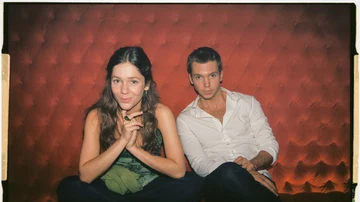
These characters, with whom the filmmaker has allowed himself a trip partially inspired by his assault on the capital in the past, are not alone. In fact, they are very well accompanied, for a gang of friends who also struggle to find their place in the world, with a previous stop at the Faculty of Audiovisual Communication. Blanca Martínez is Jimena, Roser Vilajosana is Adri and Albert Salazar is Fer. The latter is one of those collateral damage that has to grow, specifically, that of youthful love that seems to have no place in the new life recently launched, although it does not stop mattering or hurting. That is why perhaps Fer will end up traveling to Madrid after Irene, as Salazar says “he will not do it for professional reasons like the others, he will do it for love”. But oh boy! How hard to be and feel that love when Julio, the novelty, the tender look of sensitive tears, the improbable body Adonis by the number of muscles that marks enters the scene.

Adri is not for nonsense, Roser explains it well, “she wants to be a director of photography, she is not for romances” and even less for outsiders, “she has a mission and does not want to lose focus.” Jimena also knows a lot about being focused in the right place, which is why production is her thing, that is, the art of making everything go as it should, but Blanca Martínez knows that her character “cannot prevent life from go where she wants” without taking into account that things are not always what they should be.
I shared a flat at the university with Amenábar and Mateo Gil, they succeeded very quickly and it was inevitable to compare
So goes the whole gang, doing what they can in a duel facing friendship, creativity, love, talent and frustration for the search for success that either does not arrive, or does not shine as beautifully as in the imagination prior to its actual materialization. Carlos Montero is not at all alien to this because, as he himself confesses, he had “shared a flat at the university with Amenábar and Mateo Gil, they succeeded very quickly and it was inevitable to compare themselves” and that generated frustration for him.

It is curious that that circle finds closure in ‘All the Times We Fall in Love’, because Mateo Gil directs several of the eight chapters and Alejandro Amenábar makes a cameo which will have to do with the Goyas and is doubly significant because his debut film, Tésis, is heavily referenced in the series. Both Mateo and Alejandro, like Carlos himself, had to experience, as students, the limits that the system placed on them, making it difficult for them to prove their worth. That is represented in the series with a mini role of the ashen professor who is more careful in putting up barriers than opportunities, played by the Galician Xacobe Sanz.
Success came later to Montero, already in his forties and thanks to Netflix. But Irene, her alter ego in the series, never seems to get it, and that will make her pour out her demons on Julio, making their relationship burden with unfair weights that could break it while they swing on both sides of the edge of an abyss marked by her chronic unhappiness and his dangerous addictions.
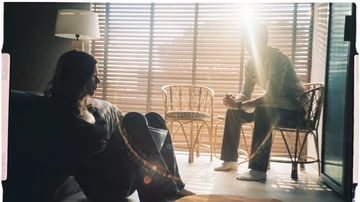
As a context, the first two thousand allowed the scriptwriters to take reality, who launched into use the attacks of March 11, 2004 as a link between some of the charactersWell, Da, Irene and Julio were on one of the trains. Somehow, that becomes a lifelong bond for them, a trauma that binds them to make it even more difficult for them to navigate their own emotions on the winding road to maturity.

