

Mercedes, despite being a premium manufacturer, has a long tradition in the commercial vehicle segment. So much so, that they boast of having created the first van in history, a title that corresponds to the Daimler-Benz Motor-Lastwagen. Although times change and now the German brand talks about electrifying all its medium and large commercials from the year 2026. Therefore, we can say that Mercedes prepares a new family of electric vans and campervans based on a novel platform of which some data is already known.
It’s about the VAN.EA platform (Van Electric Architecture) that has been developed from scratch and with a purely electrical application. It will be the one that accommodates all the vans, both those for commercial use and those for passenger transport, in the coming years. It will stand out for its modularity, because it will also give life to some off-road model and another with a higher level of luxury. The key is to reduce the complexity in the range to reach economies of scale, covering the same as today with 50% fewer variants.

This VAN.EA platform focuses on maximum efficiency, wants to offer a very high level of autonomy thanks to good values of aerodynamics or the tuning of the chassis. It is achieved through three modules, which are common to all models that are to come. The electric powertrain is integrated in the front, a mechanic that is the same in all. The central module is the one that will change depending on the length sought, integrating batteries of different capacities. The rear module may integrate a second electric motor for all-wheel drive versions or it will be free for those that remain with front-wheel drive.

Within that platform there will be different variants to adapt to the desired uses. For example, the platform VAN.EA-P It will be the one that gives life to medium-sized vans for private use, with a higher level of luxury. You want to become a VIP shuttle or a zero emission mobile office with a autonomy of more than 500 kilometers and Level 2 autonomous driving technology at launch, and Level 3 by the end of the decade.
On the other hand, the VAN.EA-C platform It is the one that medium and large commercial vehicles will carry. They will boast a modular and scalable design, always focused on the maximum interior space for courier companies, ambulances and even recreational vehicles. It will also highlight its digitization through MB.OS and will even work on a level 4 autonomous driving to deliver without a driver. The goal is to reach a 50% share in electric vehicles by 2030 and reach new markets.
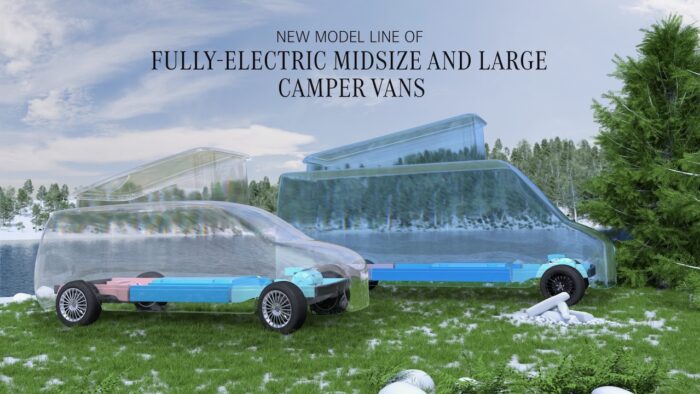
At the moment, Europe is the strongest market for the brand by bringing together 60% of sales of Mercedes-Benz Vans worldwide. Now the focus is on other markets with a lot of potential, such as the United States for large commercial vehicles or China for luxury passenger vans. In both regions, products will be offered with the VAN.EA platform and it will even reach sell camper vans with that basis.
The last piece of good news is that some of these models will beproduced at the Vitoria plant, which translates into more electrification for the Spanish industry. They will be the medium models that will arrive in the medium term.
Photo gallery:
 1/7Photos

