

Ford is exploring the possibilities of hydrogen as a fuel for your future range of commercial vehicles. Much has been said about this technology and it seems that in a few years it will be really interesting for long-distance transport that would not be possible solely in electric format. That is why he has created a small fleet of Ford E-Transit hydrogen and will perform various tests over the next three years. It is clear that a project of these characteristics is not a matter of a few months.
To carry it out, he has had the help of the Advanced Propulsion Center (APC), made up of six leading companies in the sector such as Ocado Retail, BP, Cambustion, Viritech or Cygnet Texkimp. The fact is that each one will have a fundamental role in this project of the brand of the oval in which the commercial vehicles are the protagonists. With its Ford Pro division at the helm, it will try to determine if hydrogen fuel cell technology is viable for these models.
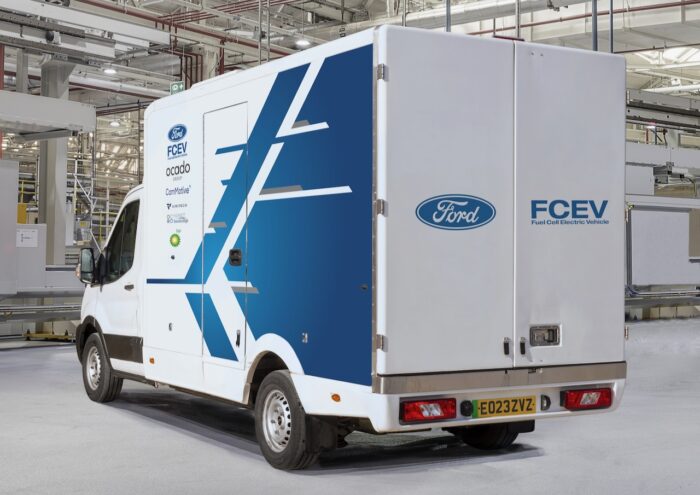
The Ford E-Transit is already a reality on the market since 2021. However, has limitations, Well, with the 67 kWh battery, it offers a range of 350 kilometers, which may be insufficient for many users. If the energy of hydrogen is added through a fuel cell that generates electricity in a clean and sustainable process, more kilometers could be added for this model that is generally used for road transport. No technical data has been given, but a transformation has been made that is already running.
There are a total of eight Ford E-Transits that They will work in periods of six months to complete a three-year testing phase. By 2025, a lot of useful data will be obtained that will allow the firm to decide if the hydrogen van is viable, taking into account total cost of ownership (TCO). Series models are produced at the plant in Turkey, but have been transformed at the Dagenham (UK) facility, which is one of Ford’s most efficient plants today.

