

Background
It all started a quarter of a century agospecifically in 1997 in Japan when Toyota presented a vehicle called Prius already in the production version of that concept car presented two years earlier -1995- at the Tokyo Motor Show.

The first generation Prius was initially sold only in Japan and was known as the NHW10.
The main characteristic of this singular vehicle -whose code name is NHW10- was not its design -which also had very particular details-, what was really interesting was its motorization made up of two power units; a traditional one with an internal combustion engine and another electric motor, thus being the first production car available to the public and that caught everyone’s attention, evidently in 1997 it was Named “Japan Car of the Year” and that country was the only one where it was available, despite the fact that it had been designed in the brand’s design studios in California. It took until the next century in the year 2000 for the Prius to be marketed outside of Japan, the second generation of the Prius was internally called NHW11 and it is the one that began to be seen in the US and had a warm reception from the consumer public that for those years was not really concerned about environmental issues, much less fuel consumption and since the story called Prius began to be told, more than five million “Prius” have been sold around the globe and today we are testing the 5th Generation of this long-awaited Japanese product
The Prius in Mexico

Incidentally, a member of the Autocosmos editorial team came across a recording of a Prius advertisement in 2010.
The history of the first Toyota hybrid in our country dates back to 2010 when in a bold and aggressive campaign the corporate in Mexico decided to launch the 3rd Generation of the Prius to the public, whose internal code became known as XW30. Initially, the reception was cold, the consumer did not show much interest in the new proposal and in the early years Toyota dealers had a hard time closing sales of the Prius.
After the story… we begin!

Toyota Prius 2023: Design
The 5th generation of the Prius is characterized by its great design, which it is far removed from the stylistic concept managed by the brand in the four previous generationsNow it looks aggressive, angular, with very well defined lines and even sexy. It is a monocoque built on the TNGA platform.
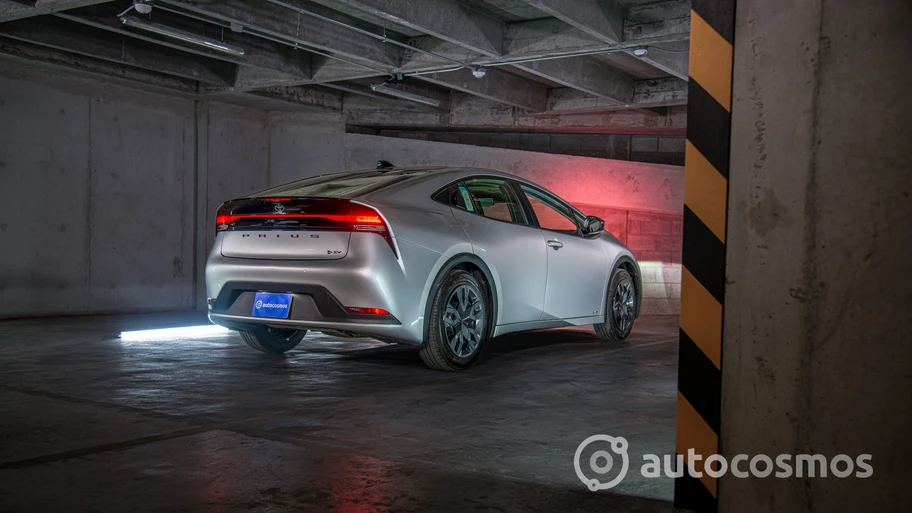
Dimensions : (in mm)
- Length: 4,599
- Width: 1,782
- Height: 1,435
- Distance between axles: 2,750
- Weight: 1,395 kilos
2023 Toyota Prius: Specifications
This is one of the most important items, because it is here where we find that mechanical bivalence that is so much talked about today with vehicles with alternative mobility.
In Prius there is a four-cylinder internal combustion engine coupled to a permanent magnet electric motor, and the traction system is provided by an automatic planetary gear transmission, the suspension scheme is independent at all four corners, using the system McPherson struts on the front axle and double wishbones on the rear axle

Technical data
combustion engine
- 1.8L displacement 4 cylinder, Atkinson Cycle
- Power: 97 hp @ 5,200 rpm
- Torque: 105 lb-ft @ 3,600 rpm
Electric Motor/Generator
- Permanent magnet synchronous (13,500 rpm)
- AC voltage: 600 volts
- Peak Power: 94hp
- Peak Torque: 185 lb-ft
Battery
- lithium ions
- DC voltage: 207.2 volts
- Number of modules: 2
- Number of cells: 28
- Capacity: 3.6Ah
2023 Toyota Prius: Interior
In this area it is also felt a very positive evolution compared to the previous generationThe first thing that stands out is the enveloping design, clearly enveloping where the front door panels are integrated into the dashboard, where two screens are installed, one MID for the instrument panel and the large central horizontal touch screen for display and government of many functions.

The upholstery is made of synthetic leather with a combination of textures that is highly resistant and easy to maintain. In general, the interior materials are of good quality and we obviously have a piano finish that stands out on the center console (it is recommended to have a microfiber on hand to keep it clean)
Toyota Prius 2023: Infotainment
Here we also find a maturity and a very good evolution in the entire information system, let’s start with the high instrument panel that no longer has any traditional needle, everything is a projection on the 7-inch screen, from there we go to the huge screen touch located in the center of the board, also in a horizontal position, easily accessible and despite measuring 12.3 inches, it does not hinder visibility.

Connectivity with Apple (CarPlay) or Android (Android Auto) devices is provided by a USB C port -data and charging- or wirelessly
2023 Toyota Prius: Safety
A good suite of driving assistance, without forgetting the airbags, of which we find seven of them, we also have the obligatory stability and traction controls and the system called TSS (Toyota Safety Sense) that prevents through audible alerts -or assists- in an imminent collision with another vehicle or a pedestrian.
2023 Toyota Prius: Driving
Driving new technologies -even if they are many years old- has its good degree of learning, in practically all hybrid cars the zero start is in electric mode, at low speeds it is also the electric motor and the battery that is in charge of mobility, it is even possible to drive about four kilometers in fully electric mode pressing the button that says EV on the center console, to achieve this you have to have the battery fully charged.

Yes ok the driver cannot directly interact with the hybrid system, that is to say, the combustion engine will start when the control unit indicates that it is necessary to do so, it is relatively easy to guess the moments in which it will start, and prevent this from happening in favor of better fuel efficiency, and obviously circulate for some peridots without emitting CO2 particles.
We have four driving modes to choose from, ECO / NORMAL / POWER and EV, which I already explained.
The idea is to drive in the city always in ECO mode, and In city traffic, be very gentle and smooth with the accelerator.Thus, we make the most of electric power, for example, on constant speed roads, we drive at 80 km/h and if we maintain a minimum pressure on the accelerator, the heat engine will turn off for a few seconds -or minutes- if we do not require sudden acceleration.

The smooth, quiet feel is a great feature of hybrids and the 5th grade Prius. Generation is no exception.
Conclusion
Today, a car with hybrid technologies -in parallel or in series- is the most appropriate if the use will be primarily in city traffic., which is where this type of technology shines the most. With this I do not mean to say that it does not behave well on roads and highways at legal speeds, and perhaps a little more, but its essence and its vocation is in large cities.
He too buying a hybrid has many tax advantages and deductibility much higher than those of a combustion vehicle, to begin with in Mexico this type of mechanics are exempt from VAT and ISAN and that means great savings. Also in cities where there are severe restrictions on movement due to environmental contingencies -as is the case of CDMX- hybrid vehicles are completely exempt from such measures and whether we like it or not, this is a real reason for purchase.

