

It is a fact that the future of mobility is electric. From manufacturers to governments, they advocate an energy transition that results in the vehicles of the future will be battery-powered, but there are also some voices that stand apart from the herd and view this trend critically.
Toyota has been warning for some time that the future is not only electric, but that there are alternatives such as hydrogen. But nowthe Japanese brand claims to bet on 100% electric vehicles is not only a bad business decision, but could be harmful to the environment.
Dr Gill Prattchief scientist at Toyota’s electromobility division, says it makes much more sense for car companies to offer cars with different power sources, including hybrids and hydrogen.

Dr Gill Pratt
The problem with electric vehicles is the availability of lithiumthe mineral used in the production of battery packs. Pratt predicts that the auto industry will soon be affected by shortages of lithium, as well as other minerals. used in the production of batteries, and also by the lack of charging points for users as demand for electric vehicles in production increases.
So if there isn’t enough lithium available to power tens of millions of electric vehicles, the most reasonable thing to do is to divvy up that rare commodity among hybrid vehicles. Because, The scientist says that manufacturing millions of hybrid vehicles pollutes much less than using the same amount of lithium to create a smaller number of pure electric vehicles.
To exemplify the above, Pratt gives us the following panorama: “Let’s take an average where 100 traditional combustion vehicles emit about 250 g/km of CO2. If we have enough lithium to make 100 kWh of batteries, we could build a top-spec, zero-emission long-range Tesla, but the remaining 99 vehicles would still run on combustion, which would give a fleet CO2 figure of 248.5 g/km, a very low average. Nevertheless, if we distribute those 100 kWh among 90 traditional hybridsleaving only 10 simple combustion cars, and average emissions drop to 205 g/kma big difference.
According to Pratt, “a crisis of shortages is looming, not only in battery materials, but also in charging infrastructure, something that will make it very clear that one size does not fit all, and that the best answer is actually a combination of different types of vehicles.”
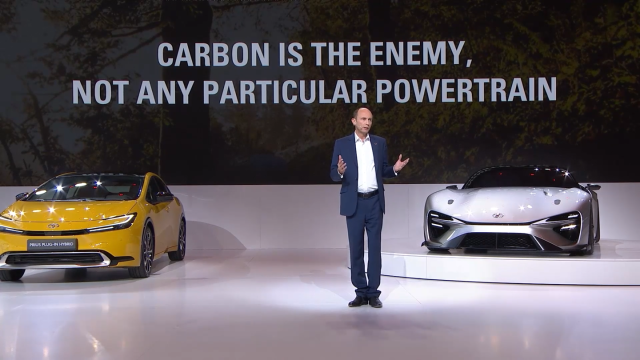
As Akio Toyoda himself, now former president of the company, said at the time, “the enemy is fossil fuel and carbon, not internal combustion engines.” Everyone agrees on zero-emission mobility, but the answer may not necessarily have to do with cars with big batteries.

