

The Japanese tire manufacturer Bridgestone, gives us an announcement in favor of the environment related to the manufacture of tires.
What’s happening?
Bridgestone reveals that it has just produced some tires demo made with 75% recycled and renewable materials.
The company has completed production of 200 demo wheels and is conducting a joint evaluation with automakers to test them on the next generation of electric SUVs and crossovers.
Where were the aforementioned tires produced?
Designed at Bridgestone’s Americas Technology Center in Akron, Ohio, The new wheels were produced at the Aiken County Passenger/Light Truck Radial Tire Plant in Graniteville, South Carolina. The Aiken plant is the first tire manufacturing facility in the United States to earn International Sustainability and Carbon Certification (ISCC) Plus certification, for transparency and traceability of sustainable raw materials, including bio, bio-circular, and circular-based raw materials. in the mass balance model. Aiken also operates an eight-acre cluster of solar panels, which provide renewable energy to assist in the plant’s manufacturing operations.
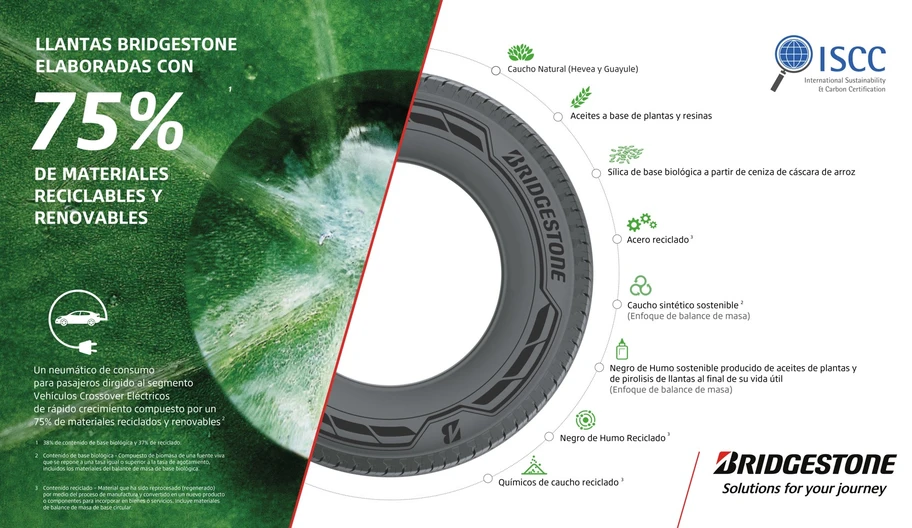
What are these 75% recycled and renewable materials made of?
Tires contain a wide variety of materials derived from recycled and bio-based raw materials. These include recycled monomer, produced from materials such as plastic bottles to create the synthetic rubber of the tire.as well as recycled steel, recycled carbon black, TPO-derived carbon black, and bio-based carbon black. Several of these materials have the ISCC PLUS certification granted by the International Sustainability and Carbon Certifier (ISCC).
Additionally, the tire incorporates natural rubber derived from the guayule desert shrub, grown at the guayule agricultural research and development facility in Eloy, Arizona.
Bridgestone has invested more than ten years and more than one hundred million dollars in the research and development of guayule as an alternative to natural rubber, imported from the Hevea Brasiliensis tree, grown primarily in Southeast Asia. Guayule can serve as an alternative to existing crops such as alfalfa and cotton, grown in the drought-stricken desert of the American Southwest, requiring only half the water to grow.
Guayule is part of Bridgestone’s plan to achieve carbon neutrality and make tires from 100% sustainable materials by 2050. The company is focused on starting commercial production of guayule-derived natural rubber by the end of the decade.
All of the above is part of the commitment that Bridgestone established, which has the goal of using 100% sustainable materials in its products by 2050. Another example of this is that it announced that it is developing tires that use 90% recycled and renewable materials for passenger cars.
How do you see what Bridgestone is doing to produce tires but at the same time take care of the environment? Leave us your comment.

