

Air conditioning is vital in a new car, especially in a country like Spain, where high temperatures are common. The generalization of its use even changed travel habits. Before, people traveled “in the cool”, avoiding the central hours of the day. Now, luckily, the temperature no longer conditions being able to make a comfortable trip.
It’s not just about comfort. Air conditioning is a security element. When you drive in the heat it is easier for fatigue to appear or for you to move more in the seat trying to find a way to cool down, increasing distractions. You also open the windows and insects or dust can enter. And beware, not only in summer. In winter it manages to demist the windows much faster by reducing the amount of humidity inside. It also helps to eliminate bad odors and purify the air.
The first cars with air conditioning
Being able to “condition” the air in a vehicle’s cabin is a fairly old idea. After diving on the Internet we found that in 1884 William Whiteley did an experiment, placing blocks of ice in a container on the roof of a horse-drawn carriage. He would then blow the air inside using a fan attached to the shaft. And yes, the temperature dropped since as the air passed through that frozen area before, it cooled.
A rudimentary system but one that was the basis for future innovations such as the Wheather Eye of Nash Motors, which (broadly speaking), lowered the temperature of the air by making it pass over water. It was implemented by their cars and also by the later AMC, in the United States. They developed it in 1938, but it was slow to reach their factory models. Contemporary was the system of hupmobile Evanair Conditioner another pioneer of fresh air hot water heating systems in the industry.

However, “cooling coils” were available in automobiles Packard for several years prior to the introduction of these systems. The first car to have air conditioning was the 1940 Packard Super Eight. It was an element that made him stand out from his competition, which is why other American luxury brands, such as Cadillac, soon included it among their accessories.
Elements of air conditioning in a car
The air conditioning system is made up of a series of components that work synchronized to ensure that the temperature in the passenger compartment is lower than that of the outside. It is a closed circuit through which a refrigerant gas circulates that is compressed and decompressed to absorb heat, release the cooled air into the passenger compartment and clean it of impurities.
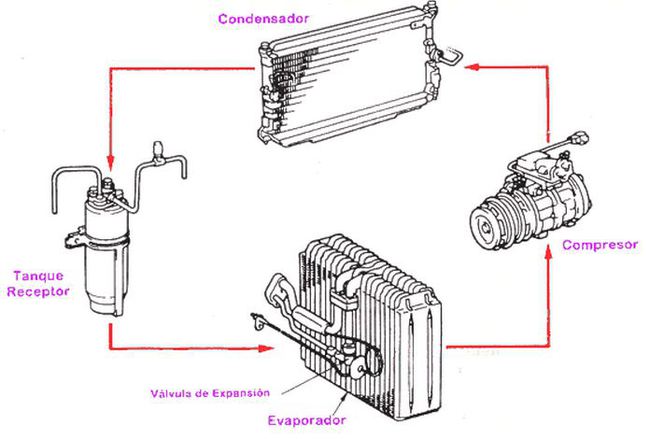
Here are some of the components of your basic schematic (obviously, there are differences between makes and models):
- refrigerant gas: Its great peculiarity is that it can change state without problem to carry out its mission. Since January 1, 2018, the gas R1234yf that complies with current anti-pollution regulations and that replaced R134a in the automotive industry.
- Compressor: Increases the gas pressure. When you flip the A/C switch in your car it starts to work, powered by the accessory belt.
- Condenser: This is a radiator located at the front of the vehicle, in front of the engine radiator. It receives the gas pressurized and filtered by the filter-drier, where the change of state from gas to liquid occurs.
- Dehydrator filter: Located between the compressor and the condenser (in some models it is part of the latter), it is responsible for filtering and drying any remaining moisture from the refrigerant gas.
- Evaporator: It is a smaller radiator than the condenser –similar to the heating one–, which cools the air that passes through it and where the refrigerant gas passes from the liquid state to the gaseous state of the refrigerant gas.
- Expansion valve: Located at the inlet of the evaporator, it sprays the refrigerant liquid inside it. In addition to regulating the flow of refrigerant liquid, it controls the expansion of the fluid at high pressure and prevents it from freezing in the evaporator.
- passenger compartment fan: It is the one that introduces the air into the passenger compartment (its intensity can be regulated, as I am sure you know).
- Thermostat: Regulates the temperature inside the passenger compartment (it is inside the car), either manually or electronically. When the desired temperature is reached, it deactivates the electromagnetic clutch so that the compressor stops working or activates it when it is exceeded.
- pressure switches: These are safety elements that, if the pressures are wrong, cut off the electrical supply to the compressor (hence, they are mounted at the inlet and outlet of the compressor).
- Pipelines: The refrigerant gas circulates through them. If they are at high pressure (about 10-20 bars) they are narrow and if at low pressure they are thicker.
How does air conditioning work in a car?
It seems like magic to press the button and fresh air comes out on a hot day. Actually, there is no trick. The refrigerant gas is compressed and becomes a liquid (warming up), while when it is decompressed, after having been filtered, it cools down. These are the steps:
- An electromagnetic clutch in the compressor compresses the refrigerant gas.
- The heated gas leaves through the expansion valve of the compressor.
- Then it goes through the condenser, where it cools (it reaches a temperature between 80 and 100 degrees) and becomes liquid (between 50 and 60 degrees) thanks to the drop in temperature produced by the air that enters and the one sent by the fans.
- In this state, it is filtered to eliminate impurities and dirt, preventing them from passing to the next part of the air circuit.
- The refrigerant liquid passes through another expansion valve, which regulates the amount of refrigerant liquid and sprays it towards the evaporator, at a pressure between 10 and 20 bars.
- It enters the evaporator, where it returns to a gaseous state (pressure at 2 or 3 bars) and cools the passenger compartment of the car before returning to the compressor.
The process starts there again in a cyclical way. The energy of the combustion engine itself is used for the compression of the refrigerant gas, no electricity.
Differences between air conditioning and climate control
Many people confuse air conditioning and climate control. Analyzed from a technical point of view they are similar, but they are not identical. Let’s analyze:
- Air-conditioning: With the wheel to regulate the fan speed, the air conditioning is activated or deactivated. The temperature regulation is manual, but maintaining it during a trip, with different outside temperatures, requires varying it. It is, yes, cheaper than an air conditioning system by having fewer components.
- air conditioning: It is capable of mixing cold air and hot air to achieve the correct passenger compartment temperature, without the occupants having to worry about adjusting it. It is more expensive since it incorporates more components, such as temperature sensors outside and inside the passenger compartment, electric motors that move the air intake flaps… and even more so if they differentiate between two, three or more zones, increasing complexity.

