

The coolant liquid (also called antifreeze, although it is only one of its functions), is vital for the proper functioning of a vehicle. Its task is that the engine works at the correct temperature, releasing heat to the outside through the radiator.
The coolant is in a tank, usually made of transparent plastic so that its level can be easily seen. Why can the coolant level drop? What can happen if we circulate with little coolant? That’s what we’re going to
Low coolant level
Checking the coolant level is very simple. Simply raise the hood and see if the fluid is between the minimum and maximum marks indicated. It is a closed circuit, you should not miss anything, it does not matter if the car has not been used for a long time or if, on the contrary, it is used a lot.
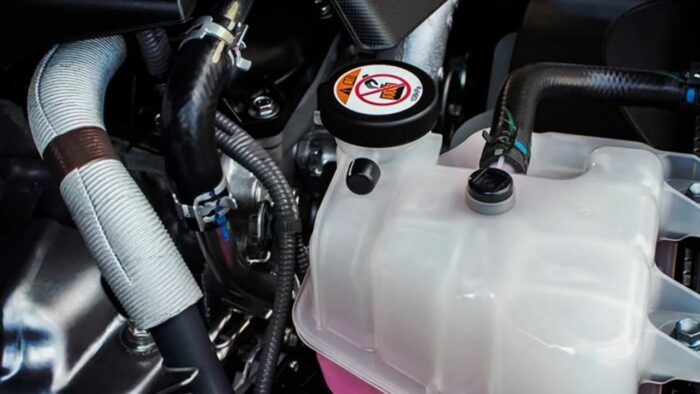
If one day you see that it is below the minimum level, the first measure you have to take is to fill the expansion tank with the appropriate coolant (always cold, to avoid scares and erroneous measurements as hot coolant expands). Then it’s time to check, after driving and with the car on a flat place, if it has gone down again. In this case there is a loss of coolant.
There are other signs that the coolant level is low:
- temperature indicator lights up on the dash or the temperature rises above 100 degrees very quickly.
- The engine fault warning light comes on.
- After a long stop, there is a puddle under the vehicle (not water, that can happen with the air conditioning). If you can see the drip, it will be easy to locate the leak.
- Bubbling in the expansion tank: it can indicate a leak of refrigerant mixed with the water.
- Signs of moisture in the engine. If there are drops it is more dangerous than only slight humidity.
- White smoke, very dense: It is one of the most feared colors of exhaust smoke. In that case the coolant enters the combustion chamber, so there are leaks in the combustion chamber. cylinder head gasket
- white spots on clamps, radiator or water pump.
- There are water in oil the motor.
Why is the coolant low?
Losses of coolant liquid always occur because the circuit has a leak or a sleeve or connection is loose. These are the most common causes:
- failure in the tank cap limiter mechanism: It is the most common reason, that the lid loses its pressure capacity and the liquid evaporates when it gains temperature. The solution is simple, change the cover. In older cars it is normal, since over time they can deteriorate.
- leaks in sleeves or clamps: They are common and easy to fix… once you find them, since the leaks occur when hot, it is easier to lose a vapor than a liquid. In case the hose is broken (by an animal bite, for example), it is easier to find them. smaller leaks can be filled with radiator sealant.
- leaks in the combustion chamber: More specifically, in the engine crankcase, because the gasket is in poor condition or there are cracks in the crankcase itself. The fix is more expensive in time and money.
- Faults in the radiator: It can escape because the radiator has a crack, due to a blow from a stone, a piece of metal…
- defective head gasket. In this case it is a loss without a leak, since the coolant reaches the cylinders. Coolant and engine oil mix and can be recognized by having stains in the expansion tank.
- Broken water pump or any of its worn parts, such as the seal.
- Battered thermostat housing or leaking temperature sensor.
After the repair, the coolant must be refilled, with the engine cold.
Can you drive with little coolant?
As soon as the coolant drops below the minimum mark on the reservoir, the warning light should come on. It is time to fill in and check if there is loss and its intensity.

If the loss of coolant is small, top up the missing fluid and go to the workshop. If it is very large, do not risk moving it, as the motor can overheat and end up deforming key components as the heat cannot dissipate. It’s time to call a tow truck.
Coolant is essential for the car engine and should not be ignored. In fact, it is not only responsible for cooling the engine (and avoiding serious problems such as engine seizure) but also protects it from corrosion, preventing calcareous formations from appearing. Hence, even if there are no losses, it should be changed from time to time. It depends on the car, but it is usually between 40,000 and 60,000 kilometers, or after two or three years.

